Sorting by

×

How Did They Decide Which Books to Include in the New Testament Canon?

If the early Christians decided they needed writings by apostles to provide them guidance in what it meant to follow Jesus – what to believe, how to act, what rituals to follow, how to understand them, etc. – how did they decide?  Which writings were they going to include?  And which exclude? I continue here my reflections on how we got the 27 books of the New Testament, some preliminary thoughts as I consider how to write a book on the topic down the road.   How Decisions Were Made Early church communities, leaders, and individuals accepted and appealed to a range texts written by apostolic authorities.  Some Christians revered the Gospel of Thomas, which maintained that it was the secret teachings of Jesus, not his death, that could bring salvation.  Other Christians accepted the divine revelation found in one of the Apocalypses of Peter (not the one I described earlier) in which Peter narrates his own most peculiar vision of the crucifixion.  It is a puzzling scene that is difficult to imagine.  The man [...]
2025-09-10T12:59:08-04:00August 23rd, 2022|History of Christianity (100-300CE)|

Did the Romans Help Create the Jesus’ Movement? Platinum Guest Post by Ryan Fleming

Platinum member Ryan Fleming has come up with three posts that may strike you as highly controversial.   Very interesting ideas.  What do you think?  Ryan will be able to engage your questions and comments. This is the first of three posts; the others will be posted -- just for you Platinum members -- over the course of the next eight days. ******************* This series of three posts proposes a theory that Christianity was born from Roman manipulation of the religious heart of Jewish resistance to their authority in Judea. Jesus’ ministries were a collaboration with local Roman authority to change the culture of the Jewish people to be more conducive to Roman rule, collection of taxes, acceptance of gentiles, submissiveness, etc. The miracles attributed to Jesus were staged with clandestine support from Rome to enhance the popularity of the movement. The Jewish people saw through Jesus’ teachings as not being divine from their god, saw his teachings as blasphemous, and as such, rejected him and called for his execution. The Roman Prefect, Pontius Pilate, did [...]

2025-09-10T12:59:21-04:00August 22nd, 2022|Historical Jesus|

Problems in the Gospels–How do YOU Talk to Believers About Them? What Do You Think?

I recently received this query by a blog member, and it's a question I often get, both on the blog and off.  I'm hoping that maybe you yourself have some wisdom on it.  How do you talk about historical and literary problems (contradictions!) of the Gospels to people who are convinced the Bible has no problems at all? Here the question is articulated very well.  What's your experience and judgment?  Let us know what you think! ****************************** QUESTION from a blog reader: I’m fairly knowledgeable about the historical Jesus. When I find myself discussing the gospels with Christians who are not, I’m always tempted to lead with statements that certain things are not accurate: Matthew, Mark, Luke, and John didn’t actually write the gospels; the four source hypothesis; contradictions in accounts by the gospels; no post-resurrection appearances in the original version of Mark; etc. This seems like a needlessly negative approach to an informal discussion. Christians most often automatically react that I’m asserting some sort of superiority and even dogmatism over them. Do you have [...]

2025-09-10T12:59:08-04:00August 21st, 2022|Canonical Gospels, Reader’s Questions|

Writings of the Apostles in the Canon of the New Testament

How did we get the twenty-seven books of the New Testament?  And why?  I’m in the middle of a thread that is meant to provide a *sketch* of how it happened; I’ll be writing a book on the question, and these are my preliminary thoughts about the topics that I’ll be covering, one at a time. In previous posts I’ve pointed out that the early Christians started out with a canon of Scripture: as Jews they had the Hebrew Bible as an authority for understanding their beliefs, ethics, and religious practices; but as Christianity began to develop its own distinctive views on things, church leaders came to think needed authoritative direction – especially since so many different Christian groups had so many different views on so many issues (not just what to believe but also how to live, how to behave, how to worship together, and so on). What could be decisive authorities? Here’s where I pick up in my thinking:   The Need for Apostolic Authorities It was widely known that Jesus himself had [...]

I’m Doing a Speaking Event in Waynesville Next Week!

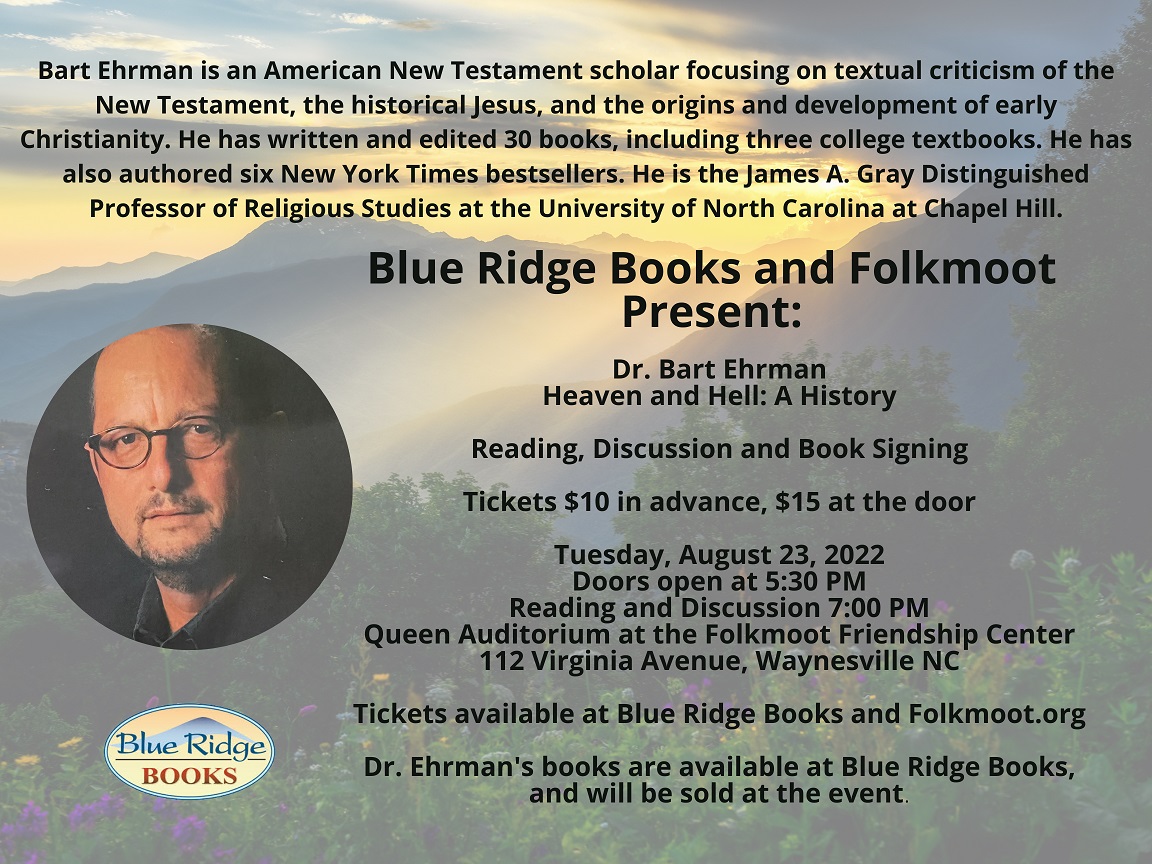
Interested in coming to hear me give a talk/book reading?  It’s next Tuesday, August 23, in Waynesville NC.  All proceeds go to the local Indie, Blue Ridge Books, a terrific bookstore that managed to survive the crisis.  I hope you can come!  

2025-09-10T12:59:20-04:00August 19th, 2022|Public Forum|

The Birth of (the Messiah?) John the Baptist? Anniversary Guest Post by James F. McGrath

I continue now with a post that was produced for us by a fellow scholar in celebration of the ten-year anniversary of the blog.  James McGrath has made several intriguing posts for us, and this one is particularly interesting.  Is it possible that stories about Jesus -- especially in the birth narratives were *originally* told about the future messiah, John the Baptist??   That the followers of Jesus took accounts originally told of John and edited them so that they now refer to Jesus?  Very intriguing!  Here's James's post. ******************* The Birth of John the Baptist: Detecting a Source from John’s Followers Behind Three Early Christian Gospels James F. McGrath, Clarence L. Goodwin Chair in New Testament Language and Literature, Butler University, Indianapolis   Anyone who has read my previous guest posts here, or who has read academic publications by Bart and myself, will know we share a great many interests in common: the historical Jesus, the development of Christology, extracanonical texts, and many more. As I have begun to turn my attention to my next major [...]

2025-09-10T12:58:36-04:00August 18th, 2022|Canonical Gospels, Historical Jesus|

Why Did Christians Even Need a Canon of Scripture?

In my previous posts on how we got the canon of the New Testament I’ve discussed several books allegedly written by Peter – one that got into the New Testament (2 Peter); one that came close to getting in (the Apocalypse of Peter – the one that gives Peter’s first-hand description of heaven and hell; NOT the “Coptic” Gnostic one that I discussed last week in two posts); one that was thought by some proto-orthodox Christians (but maybe not many) as having a rightful place (the Gospel of Peter); and one that really never had much of a chance (Peter’s letter to James). I can now set forth an overview of what I plan to cover in my book on the canon – when I eventually write it -- and the conclusions I will draw under a series of interrelated rubrics.   These can be imagined as chapter divisions, to come after an introduction that explains the importance of the question of how we got the canon, how it has become such a pressing question for [...]

Reminder: Ask Me Anything! Tomorrow! (Wed. Aug. 17).

Have you signed up yet?  See the annoucement below.  I hope you can come! ******************* We will be holding a blog fundraiser, donations voluntary, on Wednesday August 17, 8:00 - 9:15 PM Eastern Time.   It will be an Ask Bart Anything.  Any question on any topic is welcome.  If I am unable to answer, I won't.  I can only think of a few things I'd be unwilling to answer, and I'm not going to tell you what they are. We are raising money for the people suffering in Ukraine, and will split the proceeds between two of our charities: Doctors without Borders and CARE.   We are asking for voluntary donations of $30.  We would LOVE it if you could give more for this worthy cause.  Anyone who comes up with $30,000, I'll buy you a Happy Meal.  But if you can't afford $30, or can't afford anything, we completely understand.  Give what you can, if you can, and come anyway!  All are welcome. I will personally match the amount of donations we bring in up [...]

2025-09-10T12:59:20-04:00August 16th, 2022|Public Forum|

Is That One a Difference or a Contradiction?

In my previous post I began discussing the difference between differences and contradictions.  I see contradictions as a kind of difference, one that cannot be reconciled.  Some statements are just different:  Jimmy Carter was a peanut farmer; Jimmy Carter was president.  Different but not mutually exclusive.  Others are contradictory: Jimmy Carter became president in 1976; Jimmy Carter became president in 1992.   Both can’t be true at the same time. UNLESS you figure out a way to reconcile them, for example, by saying that Jimmy Carter became president twice, once in 1976 and again in 1992.  But THAT reconciliation can be shown to be false by other facts (that at Bill Clinton became president in 1992).  Eventually in a case like this, one has to concede: yes, the two statements about Jimmy Carter are in fact contradictory.  In this instance, one of them is true and the other false.  In other instances, you can have contradictory statements *both* of which are false (Bill Clinton first became president in 1962; Bill Clinton first became president in 2002).  [...]

2025-09-10T12:59:07-04:00August 16th, 2022|Canonical Gospels, Reflections and Ruminations|

The Difference Between Differences and Contradictions

There is a difference between a difference and a contradiction.   A difference can be reconciled; a contradiction cannot.  The trick is figuring out which is which. That’s obviously a big issue when it comes to reading the Gospels of the New Testament.  There are many, many differences, and there are also contradictions.  Some readers claim that all the contradictions are merely differences – that everything can be reconciled in one way or another.  These readers are almost always committed Christians who simply do not think there can be any actual contradictions, since that would mean that one of the writers (or more than one) made a bona fide mistake.  Given these readers’ particular doctrine of inspiration, well, that just ain’t right. On the other hand there are skeptical readers of the New Testament who find contradictions simply everywhere.  And, somewhat more surprising to me over the years, there are a lot of critical scholars who assume there is a contradiction in a place where in fact there is simply a difference.  I know this because [...]

2025-09-10T12:59:07-04:00August 14th, 2022|Canonical Gospels, Reflections and Ruminations|

Critical Scholarship from a Sophisticated Faith Perspective. Blog Anniversary Guest Post by Judy Yates Siker

This incredibly thoughtful guest contribution by Judy Yates Siker is part of an ongoing series I'm posting in honor of the tenth anniversary of the blog.   All the guest posts in the series are by serious scholars who have provided us with us with guest posts before, over the years; one of the striking features of these posts, as a group, is just now different they are in perspective and insight. I've known Judy well for thirty-three yeas, since she entered the UNC PhD program in New Testament Studies (in the field of Ancient Mediterranean Religions) 1989.  While doing her degree and then afterwards Judy taught at an intriguing range of schools to very different groups of students: Meredith College; American Baptist Seminary of the West, Loyola Marymount University, and San Francisco Theological Seminary -- where she eventually became Vice President. All these years Judy has long been one of my closest and dearest friends.  She is an ordained Presbyterian minister, active in church ministry now that she's retired from teaching, and living in Raleigh [...]

2025-09-10T12:58:50-04:00August 13th, 2022|Public Forum, Reflections and Ruminations|

An Equally Strange View of the Crucifixion

Yesterday I posted about the Coptic Apocalypse of Peter, which clearly differentiated between the man Jesus and the spiritual being, the Christ, who inhabited him temporarily – leaving him at his suffering and death since the divine cannot suffer and die.  That understanding of Jesus Christ is sometimes called "docetic," but strictly speaking that's not quite right.   The term docetic comes from the Greek word DOKEO which means “to seem” or “to appear.”  It refers to Christologies in which Jesus was not a real flesh-and-blood human but only “seemed” to be. In reality, what they saw, heard, and touched was a phantasm. That is not what is going on in the Coptic Apocalypse of Peter.  Here there really is a man Jesus – flesh and blood like the rest of us.  But he is indwelt by a divine being who leaves him at his death, abandoneding him to die alone on the cross.  That is similar to a docetic view, but also strikingly different.  I call it a “separationist” Christology because it separates Jesus from [...]

August Gold Q&A

Dear Gold Members, Yet again, it's time for our monthly Gold Q&A.   Have a question?  Ask it!  It can be anything related to the blog. To enter your question on to the list: send it to Diane at [email protected] The DEADLINE for your question is this Sunday, August 14 midnight (whenever midnight is where you live).   I will record the session soon thereafter and, if all goes to plan (does it ever?) have it released by August 18. Questions that are relatively short (a sentence or two) are more likely to be chosen; and feel free to trip me up!   Bart  

2025-09-10T12:59:20-04:00August 10th, 2022|Public Forum|

The OTHER Apocalypse of Peter (Stranger still…)

In a previous post I discussed the Apocalypse of Peter that was considered by a number of early Christians to be an inspired book of Scripture.   There is another early Christian book with the same name, which is differentiated from the "proto-orthodox" one I've already discussed by being normally referred to as the "Coptic Apocalypse of Peter."   It is intriguing both because it has a view of Christ completely different from what became the orthodox view (here the man Jesus and the divine Christ are actually different beings who are temporarily united up to the point of Jesus' death), and because it claims those with a different view (e.g., the view that "Christ died for the sins of the world") are the heretics! Here is how I discuss it in my book Lost Christianities: ****************************** Among the gnostic attacks on the superficiality of proto-orthodox views, none is more riveting than the Coptic Apocalypse of Peter discovered at Nag Hammadi.  This is not to be confused with the proto-orthodox Apocalypse of Peter in which Peter is given a [...]

Ask Me Anything! Mark Your Calendar.

We will be holding a blog fundraiser, donations voluntary, on Wednesday August 17, 8:00 - 9:15 PM Eastern Time.   It will be an Ask Bart Anything.  Any question on any topic is welcome.  If I am unable to answer, I won't.  I can only think of a few things I'd be unwilling to answer, and I'm not going to tell you what they are. We are raising money for the people suffering in Ukraine, and will split the proceeds between two of our charities: Doctors without Borders and CARE.   We are asking for voluntary donations of $30.  We would LOVE it if you could give more for this worthy cause.  Anyone who comes up with $30,000, I'll buy you a Happy Meal.  But if you can't afford $30, or can't afford anything, we completely understand.  Give what you can, if you can, and come anyway!  All are welcome. I will personally match the amount of donations we bring in up to $5000. Moreover, if there are any individual donations over $1000, I will be happy [...]

2025-09-10T12:59:20-04:00August 9th, 2022|Public Forum|

You Don’t Think Peter Wrote 1 and 2 Peter?

In my previous post I indicated that I didn't think Peter wrote 1 and 2 Peter.  One of my main reasons for thinking so is that I'm pretty sure Peter could not write.  These books were composed in highly literate Greek by someone skilled in Greek composition.  To be able to compose a book took years and years of training starting with childhood.  Everyone we know like that was elitely trained and connected with a wealthy family, almost always in an urban area.  Not, for example, a rural Aramaic-speaking daylaborer from a remote part of Galilee. But couldn't Peter have "written" these books some other way -- e.g., by having a secretary or scribe do it for him?  I dealt with that question many years ago on the blog (based on much fuller discussions in my books Forged and Forgery and Counterforgery, if you want to see more of the evidence and logic) and still think the same thing.  As it turns out, there is New Testament evidence about Peter’s education level.  According to Acts [...]

A Major Forgery in the Hebrew Bible? Platinum Guest Post by Dennis Folds

I am pleased to publish this insightful and intriguing Platinum guest post by Dennis Folds, for all you fellow Platinum members.  Many of you are interested in Christian pseudepigrapha (= forgeries), especially those in the New Testament.  But what about the Old Testament?  Now *here* is a bold thesis!  Read it and remark! Remember: you too can submit a Platinum guest post.  It does not have to be sophisticated, learned, or novel.  Just write something you'd like to share with all of us, on anything at all connected to the blog and send it to me! ******************** Jeremiah Versus the Deuteronomist Forger   Dennis J. Folds, Ph.D. Given the interest in potential forgeries of NT books and other early Christian writings, I’d like to describe what may have been the most consequential forgery in the history of our Judeo-Christian faith:  the “discovery” of the long-lost book of the law of Moses, which purportedly contained the original covenant between YHWH and the Hebrews. The discovery is described in 2 Kings 22, during the renovation of the [...]

2025-09-10T12:59:20-04:00August 8th, 2022|Forgery in Antiquity, Hebrew Bible/Old Testament|

Why Do Some Smart People Just Not Think?

I was recently contacted by a conservative Christian theologian who was interested in doing a public back and forth with me, not necessarily a debate but an exchange of ideas on the issue of theodicy – how to explain evil in a world over which God is sovereign. What puzzled me was his explanation for suggesting the event.  He said he had followed my work for years and had read my books, but was surprised recently to find out that the reason I no longer believed in God not “for historical reasons” but because of the problem of suffering. I have to say, I found this comment to be completely mystifying.  I still do. Not for the rather obvious reason that, contrary to what he said, he clearly had *not* been following me for many years or read my books.  A constant theme of my work (blog, books, interviews) is that I became an agnostic because of the problem of suffering.  One of my books, God’s Problem, is devoted specifically to the issue, and it [...]

2025-09-10T12:59:07-04:00August 7th, 2022|Bart's Critics, Reflections and Ruminations|

Reading Genesis—Are You Lost in Translation? Anniversary Guest Post by James Tabor

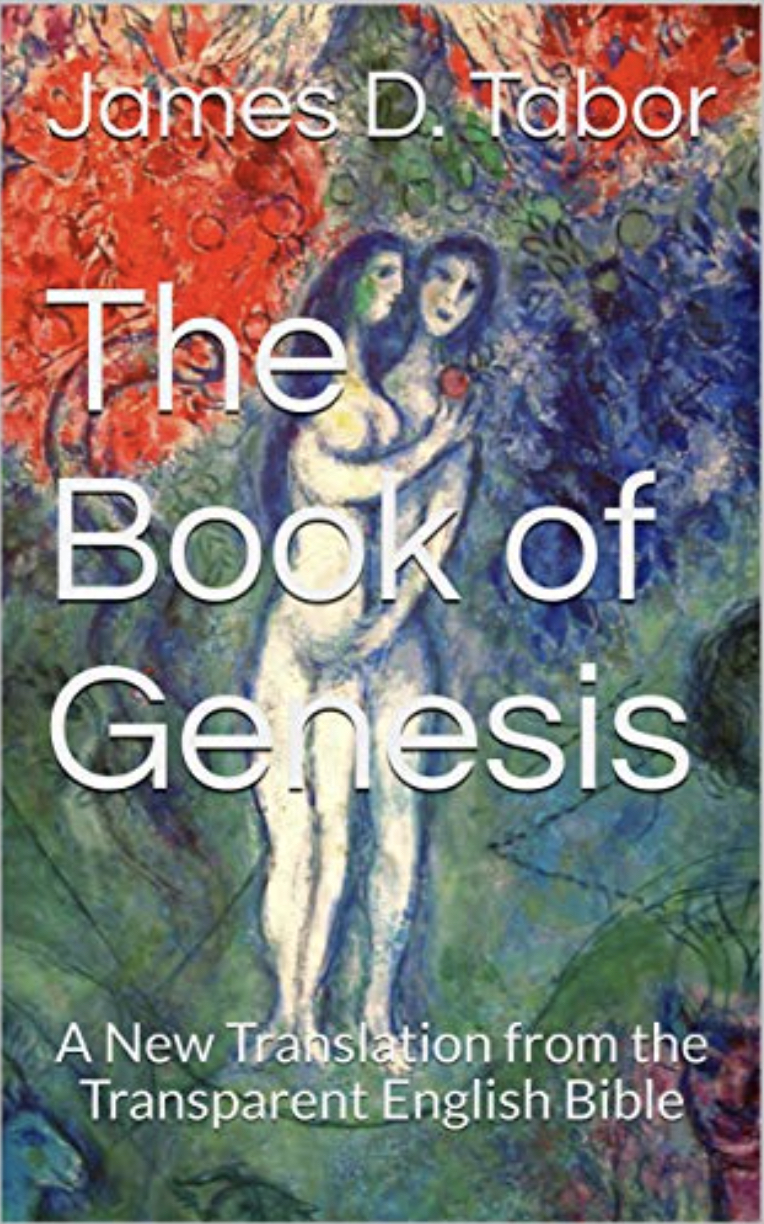
Several scholar-friends and colleagues graciously have written guest posts for the blog to celebrate our tenth anniversary.  I am posting one a week and we will gather all of them together down the line to make them available as a group.  This week's contribution comes from James Tabor, retired Professor of Christian Origins and Bible from the University of North Carolina at Charlotte (a scholar many of you will know) who has written a large number of popular books, along with serious scholarship, and most recently his own fresh translation of the book of Genesis. This post is especially interesting: James deals with problems of translating the Hebrew Bible that I bet you don't even realize are problems. ****************************** What is the best-known verse in the Bible—one that millions could quote immediately by heart? Christians might say John 3:16—after all, one even sees placards and signs reading “John 3:16” at sporting stadiums! But I think the very first verse of the Bible—Genesis 1:1—most likely would win the universal familiarity content: In the beginning God created the [...]

2025-09-10T12:58:50-04:00August 6th, 2022|Public Forum|

A Writing of Peter that *Barely* Got Into the New Testament

  In my previous posts I’ve talked about writings that claimed to be written by Peter, the closest disciple to Jesus – a Gospel, and Apocalypse, and an Epistle . These are not the only Petrine writings floating around in the early church.  Among other things, we have two other (different) apocalypses, one of them unusually fascinating that was discovered only in 1945 (a Gnostic writing). None of these was actually written by Peter, and I don’t think there’s a biblical scholar on the planet who seriously thinks it was.  It appears that writing books in the name of Peter was something of a cottage industry in early Christianity. That should give us pause.  There are two books that also claim to be written by Peter that actually are in the New Testament.  If we know that such pseudepigrapha were floating around, on what grounds should we think these two were authentic? Of all the books of the NT that have been thought to be forged – written by an author falsely claiming to be [...]

2025-09-10T12:59:07-04:00August 4th, 2022|Public Forum|
Go to Top