Sorting by

×

Time Again: Vote on your favorite Platinum Post

Dear Platinum members, That time again — an opportunity for you to vote on one of our Platinum guest posts, to see which one will be posted on the blog at large.  Take a look — they’re all terrific.   To vote, just send a quick note to Diane at [email protected]  Your deadline:  this Saturday, June 18, midnight your time. And remember — you’re always welcome to submit a post yourself.  Anything connected to the blog that strikes your fancy that you’d like others to read about?  Any ideas/thoughts you’d like to have disseminated and discussed?  Here’s your chance.  Just zap me a note. March 14, 2022 How Luke Rewrote Matthew’s Nativity Story Platinum Dennis J. Folds April 29, 2022 The Plausibility of the Fourth Gospel: The Chronology of Jesus’s Ministry. Dennis J. Folds May 20, 2022 Early Christianity and War. Dan Kohanski May 31, 2022 Who Buried Moses? Lou Suarez    

2025-09-10T12:58:35-04:00June 14th, 2022|Public Forum|

Another Historical Scholar’s Understanding of the Resurrection

I am reposting the ten blog posts made on April 18 (or thereabouts) in celebration of our tenth anniversary of the blog.  Here now is a particularly important one from 2017; at the time I was working on my book How Jesus Became God and thinking hard about how to understand the early Christian claims that Jesus had been raised from the dead. ****************************** One of the first books that I have re-read in thinking about how it is the man Jesus came to be thought of as God is Gerd Lüdemann’s, The Resurrection of Christ: A Historical Inquiry (2004). Lüdemann is an important and interesting scholar.  He was professor of New Testament at Göttingen in Germany, and for a number of years split his time between there and Vanderbilt Divinity School in Nashville.  He is a major figure in scholarship, and is noteworthy for not being a Christian.  He does not believe Jesus was literally, physically, raised from the dead, and he thinks that apart from belief in Jesus’ physical resurrection, it is not [...]

2025-09-10T12:58:21-04:00June 14th, 2022|Book Discussions, Historical Jesus|

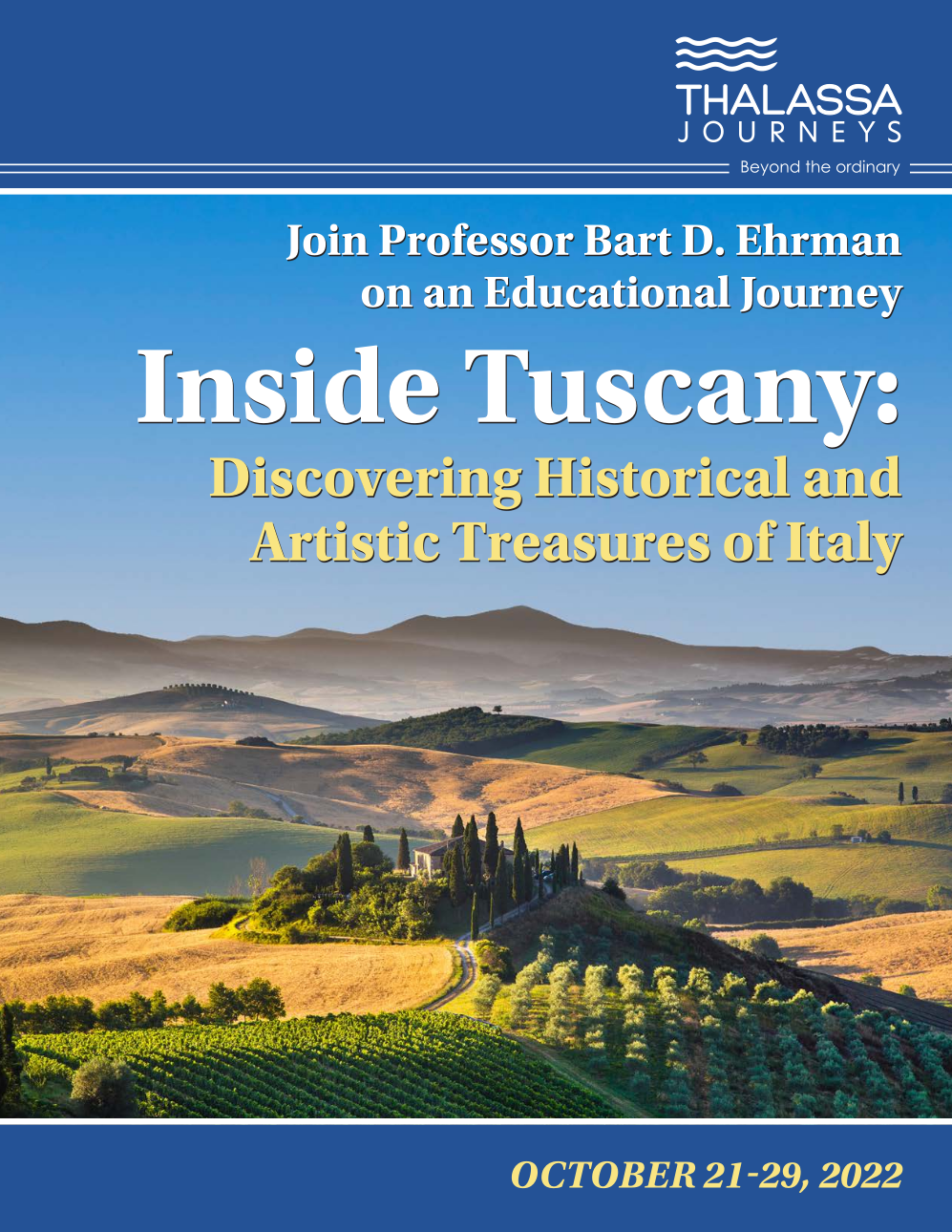
Interested in Joining Me on a Tour To Tuscany?

Now HERE is a happy announcement. I will be giving lectures on a tour to my favorite place in the known universe, Tuscany, on October 21-29, 2022.  That is, in  less than five months.  WHOA!  Wanna come? It will be a small group (no more than 18 folk, I should think), we will be spending time in Florence (which has more culture per square foot than anywhere in the cosmos); Siena (which I like even better); and surrounding towns/villages (that take your breath away). In addition to the lectures, I'll be hanging out with the people who come, day and night.   A good bit of that time will involve pizza, pasta, gelato, and, for those inclined, some of the best wines in the history of the planet. This is with Thalassa tours.  Interested?  Here is the brochure.  Check it out: just click on it and you'll get the full scoop.  And any questions, let me know.  

2025-09-10T12:58:21-04:00June 12th, 2022|Public Forum|

And Did Paul Write 2 Thessalonians?

In my last post I discussed whether Paul wrote the letter of Ephesians, whose author claims to be Paul, and explained why scholars widely think that in fact it was someone else.  I discuss all the Pauline "forgeries" of early Christianity (including the six in the New Testament) in my book Forged.  Here I thought it might be useful to consider a second example that involves a different set of problems: the "Second letter to the Thessalonians."  Again, this is taken from my book Forged (San Francisco: HarperOne, 2012). ****************************** As a conservative evangelical Christian in my late teens and early twenties, there were few things I was more certain of, religiously, than the fact that Jesus was soon to return from heaven to take me and my fellow believers out of the world, at the “rapture” before the final tribulation came.   We read all sorts of books that supported our view.  Few people today realize that the best-selling book in English in the 1970s, apart from the Bible, was The Late Great Planet Earth written [...]

2025-09-10T12:58:21-04:00June 11th, 2022|Forgery in Antiquity, Paul and His Letters|

Controversial Me….

I am having a ten-week long celebration of our ten-year anniversary, from this past April 18, by reposting all the previous April 18 posts, one a week.  Many of them I'd forgotten about.  This one is about how weird it is to me that people think I'm controversial....  (As usual, I'm a bit tetchy about it!) ****************************** In this post I am going to take a bit of time out to do some self-reflection.  An issue I’ve been puzzling over for some time is the fact that people keep referring to my work as “controversial.”  I hear this all the time.  And truth be told, I’ve always found it bit odd and a disconcerting.  This past week I’ve had two people tell me that they know that I “like to be controversial.”   That’s actually not the case at all.   One person told me that she had seen a TV show where someone had said that they didn’t believe that Jesus existed, and she thought that was right up my alley.  I didn’t bother to tell [...]

2025-09-10T12:58:07-04:00June 9th, 2022|Bart’s Biography|

Did Paul Write “Paul’s Letter to the Ephesians”?

Here's an important question I received recently from a blog member: Someone told me that “I should never listen to you” because you say Paul did not write six letters of the New Testament, even though the letters start with the claim he did:  "Paul, an Apostle of Christ to the Church at ….."  This person's main issue was: what is the evidence Paul did not write Ephesians? Your thoughts. Response This is an issue I dealt with directly in my book Forged: Why The Biblical Authors Are Not Who We Think They Are (San Francisco: HarperOne, 2012).  Here's what I say there.  (If you are interested in the hard-core academic and detailed discussion of the evidence, I have a much fuller discussion in my book Forgery and Counterforgery) ****************************** When I was teaching at Rutgers in the mid 1980s, I regularly offered a course on the life and teachings of Paul.  One of the textbooks for the course was a book on Paul by a conservative British scholar named F. F. Bruce.[1]  I used the [...]

An Even More Unusual Story of What Happens to the Rich…

In my last post I began to discuss Jesus’ parable of the Rich Man and Lazarus from Luke 16) and I mentioned there is a very similar tale in ancient Egyptian lore, about a man named Setne and his adult son Si-Osire. In the story the two of them are looking out the window of their house and see the coffin of a rich man being carried out to the cemetery with great honors.  They then see the corpse of a poor beggar carried out on a mat, with no one attending his funeral.   Setne says to his son: “By Ptah, the great god, how much happier is the rich man who is honored with the sound of wailing than the poor man who is carried to the cemetery.”  Si-Osire surprises his father by telling him that the poor man will be much better off in the afterlife than the rich one.  He surprises him even more by proving it. He takes Setne down to the underworld, where they see how the unrighteous are punished, [...]

2025-09-10T12:58:20-04:00June 7th, 2022|Afterlife, Greco-Roman Religions and Culture|

Lazarus and the Rich Man: What To Do with Wealth

I’ve been thinking a good bit about the problem of wealth in the teachings of Jesus.  Among the passages that are obviously relevant is the famous parable of Lazarus and the Rich Man.  I talked about the story in my book Heaven and Hell (Simon and Schuster, 2020).  The following is a revised version of what I say there. The story appears in Luke 16:19-31 in the context of a number of parables and other sayings of Jesus.  In the parable Jesus contrasts the life and afterlife of an anonymous rich man and a destitute beggar named Lazarus.  The wealthy many is dressed in fine clothes and enjoys sumptuous meals every day.  Lazarus lies outside his gate, starving, desperate even to get the scraps off the rich man’s table.  The scene is pathetic:  dogs come up and lick Lazarus’s wounds. Both men die at about the same time.  Lazarus is Members of the blog get five posts a week in exchange for a small membership fee -- every penny of which goes to charity.  So [...]

2025-09-10T12:58:20-04:00June 5th, 2022|Canonical Gospels, Historical Jesus|

Free Webinar on June 12! Did Matthew, Mark, Luke, and John Actually Write Matthew, Mark, Luke, and John?

Interested in a free lecture on who wrote the Gospels? As you may know, I’ve started doing some online courses on the Bible (and related topics) as part of my new venture, Bart Ehrman Professional Services (= BEPS).  This venture is not connected with the blog, but I do like to announce what is going on over there since a number of blog members have been interested. If you want to see what it all involves – and to see which courses are already available – you can find them on my personal website, www.bartehrman.com. The courses are for purchase, but I’ve decided to do a freebie for anyone interested.  It will be a live event on Sunday June 12, 2:00 pm ET; a recording of it will also be made available. The title of my talk:  “Did Matthew, Mark, Luke, and John Actually Write Matthew, Mark, Luke, and John”?    Here's the link: https://us02web.zoom.us/j/81200470127?pwd=bU82SGFTT3lLdlhSbkEwdnNrcWFQdz09 If you'd like to officially register for the event (this is not necessary but if you do so, we will [...]

2025-09-10T12:58:21-04:00June 4th, 2022|Public Forum|

How Do You Get a Book Published??

I am celebrating the tenth year anniversary of the blog, this past April 18, with previous year's April 18 blog posts.  Here's the one from 2016 -- highly relevant to prospective authors.  How can you publish a book you've written? ****************************** I regularly get emails from people who want to break into publishing for the first time, who ask me “How can I get my book published?”  As I indicated in my previous posts, almost always what they have in mind is not a work of scholarship for scholars but a trade book for a general audience.  And so here is a weird fact about me: even though I have been publishing trade books for eighteen years, I’m not completely sure of the answer.  But I know some things, and in this post I’ll indicate what those things are. I absolutely know how one gets his or her first scholarly book published.  I help my graduate students, and other scholars just starting their careers, do that all the time.  There I’m an expert.  But a [...]

2025-09-10T12:58:20-04:00June 4th, 2022|Book Discussions, Public Forum|

You Mean Everyone (Except the Truly Destitute) Needs to Give? But How Much?

The Christians who began to say that (unlike in the Roman world) the rich ought to give to the poor did not come up with the idea themselves.  As we have seen, they were replicating (in a new form) what was found in the Hebrew Bible as taken up, as one would expect, by the historical Jesus.  But the Christians ran with the idea, and that ended up having a lasting effect on all of society and Western culture. The records of earliest Christianity are pretty clear:  everyone (not just the rich) needed to give in order to help those who were less fortunate.  According to the book of Acts, the members of the first community in Jerusalem sold everything and shared all things in common, so that no one was in need (Acts 2:43-45; 4:32-37).  This sounds like Jesus’ own vision, though whether Acts can be trusted to describe social reality soon after Jesus’ death is another question.  It is clear, however, that years later the churches of Paul, populated predominantly by those without [...]

A Christian NDE and the Problem with Being Filthy Rich

I have begun to describe the Acts of Thomas, the account of the apostle Thomas’s missionary journey to take Christianity to India.  After the author describes the apostle’s adventures en route to his destination, he gets to the heart of his story – which involves, among other things, an emphasis about what rich folk are supposed to do with their money if they want to be pleasing to God and have eternal life.  Again, this description is taken from my book Journeys to Heaven and Hell (Yale University Press, 2022). ****************************** When Thomas arrives in India he is introduced to King Gundaphorus, his new master, who has acquired him for his carpentry skills, which obviously run in the holy family.  Gundaphorus wants a new palace in a remote site and Thomas is perfect for the job: he works in wood and stone and has experience constructing regal dwellings. This Act is all about the distinctive kind of building he can make. The apostle draws a design for the structure, the king approves, bestows a hefty [...]

Who Buried Moses? Platinum Guest Post by Lou Suarez

Now *this* is a topic you probably haven't thought much about -- but it's really interesting.  And puzzling!  Platinum member Lou Suarez has written an intriguing assessment of a real conundrum in the Hebrew Bible that, as it turns out, proved significant in the Jewish tradition.  It has to do with the death and burial of Moses.  Read on! (And remember: you too can post for your fellow Platinums.  Your post does not have to be high-level scholarship: if you've got something you'd like to talk about, draft something up and get your thoughts out there to a very generous reading public!) ****************************** In Deuteronomy 34, YHVH tells Moses that, even though he has led YHVH's people out of enslavement in Egypt and through the wilderness to the edge of the Promised Land, he will not be allowed to cross over the Jordan River and take part in the Israelite conquest of Canaan. YHVH permits Moses to see, from the top of Mount Nebo, "the land of which [he] swore to Abraham, to Isaac, and [...]

2025-09-10T12:58:21-04:00May 31st, 2022|Hebrew Bible/Old Testament|

Thomas’s Trip to India and the Problem of Wealth

Some Christian writers thought having lots of money was a very serious problem – both because it made rich folk focus on something other than spiritual realities and because it was not just or godly for some people to be loaded when others were starving. And so we have ancient Christian authors urging the wealthy to give away all their material possessions for a greater good and practice rigorous asceticism.  The “good” in this case was very different indeed from what was promoted in the broader Roman world -- where what mattered was helping with the city’s finances and assisting those of one’s own family or socio-economic class, in exchange for acquiring a higher personal status -- since for Christians involves helping the indigent.  But the personal motivation is roughly the same: it is a matter of “working out your salvation.”  That is, it is largely about one’s own well-being. Other writers, however, argued that wealth was not itself evil or necessarily a trap, an obstacle to the good and holy life.  Righteous people could [...]

Apologies to Gold/Platinum Members!

I need to apologize for being late on the Gold Q&A this month.  I've been in Italy the past two weeks giving lectures for a tour group; I had hoped to be able to squeeze in a recording of the Q&A while there, but the trip had me running from dawn to dark. I've just arrived back stateside now and, as we speak, am in catch-up mode.  I have the Questions for the Q&A, and now just need to record Answers.  But given re-entry obligations, it probably will not be till next week (May Q&A in June!).  And about then we'll be soliciting new questions for June. So sorry 'bout this!  On the upside, at least with the blog, a day is not as a thousand years.... Bart

2025-09-10T12:58:21-04:00May 30th, 2022|Public Forum|

A Lively Interview on my New Book “Journeys”

I've done a number of interviews over the years for my trade books (for general audiences), but almost NEVER for one of my academic books.  But here is one, on my recent book Journeys to Heaven and Hell: Tours of the Afterlife in the Early Christian Tradition.   The book is geared to academics (as you'd see from the very opening), but some is accessible to general readers (including the bits on wealth I've been summarizing here). This interview is *completely* accessible, and it's done by a very good interviewer, Mitch Jeserich for the podcast Letters and Politics.  He knows a lot about the history of early Christianity and the broader ancient world, and he asks well-targeted questions.  Some interviews are a bit of a pain; this one was all pleasure.  See what you think.  

2025-09-10T12:58:07-04:00May 29th, 2022|Afterlife, Book Discussions|

Concerns for the Poor in the Jewish Tradition

I have begun to contrast the Christian views of wealth and the need for the rich to help the poor with typical pagan views that placed almost no emphasis on helping those in need.  It is impossible to understand the Christian emphasis on almsgiving without situating it in its originating context – the Jewish tradition, going all the way back in the oldest Scriptures of Israel. Unlike the pagan tradition, the Hebrew Bible consistently pronounces God’s concern for the poor and repeatedly instructs those who have means to assist them.  Thus in the Torah itself: “Give liberally and be ungrudging […], for on this account the Lord your God will bless you in all your work and in all that you undertake.  Since there will never cease to be some in need on the earth, I therefore command you, ‘Open your hand to the poor and needy neighbor in your land.’” (Deut. 15:9-11).   Many of the most emphatic passages occur, as one might expect, in the prophets: Blog members get beefy posts five times a [...]

What the Earliest *Christians* Thought About Wealth

So far I have been discussing why “wealth” was sometimes seen as a problem by moral philosophers in the Greek and Roman worlds.  People who either have or want to have huge amounts of money are neglecting what they really need for ultimate happiness.  And money can corrupt morals, making one greedy, rapacious, and inclined to general nastiness.  These pagan ethical discourses are written by elites, for elites, concerned for the personal welfare of the elites. Christians had different views, at least so far as we can tell from their writings.  Whereas the “problem of wealth” was occasionally discussed among pagan moral philosophers, it became a central focus of interest in parts of the Christian tradition, starting with Jesus himself.   For the historian of religions that comes as no surprise.  Jesus himself was thoroughly Jewish and there are few aspects of Jewish ethical discourse more distinctive than the repeated emphasis both that the God of Israel was the God of the poor and that his people were to care for those who were in need.  [...]

Shouldn’t the Upper Classes Help the … Upper Classes?

In my previous post I talked about the widespread sense in the ancient Greek and Roman worlds that the affluent should give away some of their money.   But to whom/what did they give it and for what reasons? The basic answer involves an entire system of giving that is now widely known as “euergetism.”  The term was coined by an early twentieth-century French scholar of antiquity, André Boulanger; it literally means (financial) “good work.”  It is probably best translated into English as “benefaction.” Euergetism widely involved two kinds of giving by those with wealth: This post describes aspects of giving completely different from what we think of as "charity" today.  Join the blog and you can see what it's all about! Click here for membership options   Obligatory giving, usually called giving ob honorem (meaning something like “for the honor of). These were “gifts” that were required to be given by those who had been elected to a public office.  As part of that “honor” they were required to give of their private resources [...]

2025-09-10T12:58:07-04:00May 25th, 2022|Greco-Roman Religions and Culture|

Does Wealth Make You More … Virtuous?

I have been explaining that among those few people who thought having substantial wealth was a “problem” in the Greek and Romans worlds – that is, the few philosophers who thought about the issue (since for most people getting lots of money was precisely not a problem!) – the issue was never that it just wasn’t fair for some people to be barely able to get by, or worse to be starving to death, when others were blissfully rolling in the dough.  The issue was that having lots of money almost always corrupted someone’s character, and having a bad personal character was a problem for the person personally (and for broader society) (but not because others were poor as dirt).  The greedy, manipulative, self-centered, tyrannical personality was not someone you wanted to be or be around. And so the problem with wealth was that it could hurt the person who had it.  Those poor people:  burdened with wealth!  But what was the solution for them?  We have seen: there were two well-attested options.  At one [...]

2025-09-10T12:58:07-04:00May 24th, 2022|Greco-Roman Religions and Culture|
Go to Top