
Search
Advanced search
Platinum Webinar for December: “O Little Town of Nazareth? Where Was Jesus Actually Born?”
You are unauthorized to view this page. Username Password Remember Me Forgot Password
Tags: Platinum
December 5, 2023
Did Luke’s Gospel Originally Contain a Virgin Birth?
A couple of weeks I gave a two-lecture online course called “Jesus, The Actual Son of Joseph: The New Testament Evidence” (not connected with the blog; you can learn more about it on my website www.bartehrman.com/courses). It was an interesting experience for me, in part because it made me think of things and look into things I hadn’t thought or looked into before, and in part because it made me look back at some of the work I had done before but not thought about in a long time. That included a paper that I gave twenty years ago now at the British New Testament Conference organized by Mark Goodacre, back when he was still teaching a the University of Birmingham in England. For this more recent course I re-read the paper (not remembering it!) and (having read it again) thought that it would be interesting to excerpt here on the blog. It was delivered for scholars of the New Testament, but I wrote it so that it would not be overly technical or jargony, […]
December 12, 2023
No Virgin Birth? Was Jesus ADOPTED by God to be His Son?
Did Luke originally have the story of Jesus’ virgin birth? In my previous post I gave reasons for suspecting that Luke did not originally have chs. 1-2 (the birth narratives), but that it started (after what is now the preface in 1:1-4) with what is now 3:1. One of the reasons it is hard to know for certain is because we simply don’t have much hard evidence. Our two earliest two manuscripts of Luke, P75 and P45, are lacking portions of Luke, including the first two chapters. We can’t say whether they originally had them or not. Our first manuscript with portions of the opening chapters is the third century P4. But our earliest patristic witness is over a century earlier. As it turns out, the witness is the heresiarch Marcion, and as is well known he didn’t have the first two chapters! As early as Irenaeus’s Adversus Haereses (1. 27. 2) Marcion was accused of excising the first two chapters of his Gospel because they did not coincide with his view that Jesus appeared […]
December 13, 2023
Why Would an Editor ADD the Virgin Birth to Luke?
Is it possible that Luke’s Gospel originally lacked the story of the Virgin Birth, but that it was added later in order to make the book more “orthodox”? That’s the question I’m pursing in this thread, based on a paper I delivered to a group of NT scholars 20 years ago. ****************************** It appears that in the earliest form of Luke’s Gospel, what we have is an account that locates Jesus’ adoption/appointment to sonship, and its accompanying empowerment, at the baptism, when God declared “Today I have begotten you.” It is true that throughout the work of Luke – Acts there are other kinds of christological traditions preserved as well – especially in the speeches of Acts. But many of these are also adoptionistic, even though they appear to embody an even earlier adoptionistic notion that it was at the resurrection, not the baptism, that God conferred a special status upon Jesus and invested him with a special power.
December 14, 2023
How Did Early Christians Make Unorthodox Texts Seem Orthodox?
I’ve been arguing that Luke’s Gospel originally may not have had the story of Jesus’ virgin birth but portrayed Jesus as being adopted by God to be his son at the baptism. In the previous post I explained one strategy that could be used to “tame” an otherwise important and beloved text when it held a view that could be seen as problematic. You could edit it. But there are other ways as I explain here (taken from a paper I delivered orally to a group of scholars) ****************************** A second strategy that could be used and was used by proto-orthodox Christians to constrain the reading of the text was by putting it in a canon of writings, a collection of texts with varying perspectives which, once placed together, affected how each one would be read. I’ll not spend much time discussing this strategy, as it is familiar enough to all of us here. It was familiar enough to early Christians as well, as early as Irenaeus, who points out in a famous passage in […]
December 16, 2023
Interpreting a Text to Make It Seem Orthodox: Luke and Its View of Jesus
In my previous post in this thread I tried to show how one way to show that a text that embraced a “problematic” view (e.g., a potentially heretical understanding of Jesus as an *adopted* son of God instead of, say, the *eternal* son of God) was by interpreting it in light of *other* texts that held more acceptable views. I named an example in my previous post. I end the thread here with this one. ****************************** A similar emphasis might be detected behind the entertaining stories of other infancy Gospels, including the one that is arguably the earliest, the Infancy Gospel of Thomas. It’s true that later authors like Irenaeus found this set of tales distasteful and even heretical; according to Ireneaus (assuming that he was referring to our Infancy Thomas, which I think he was; Adv. Haer 1:20) this was a gnostic text that inappropriately emphasized Jesus’ gnosis at a young age, when confronting his teachers with supernatural knowledge. But there’s little in the text itself actually to suggest a Gnostic origin. In fact, […]
December 20, 2023
Biblical Monsters and Their Violent God! Guest Post by Esther Hamori
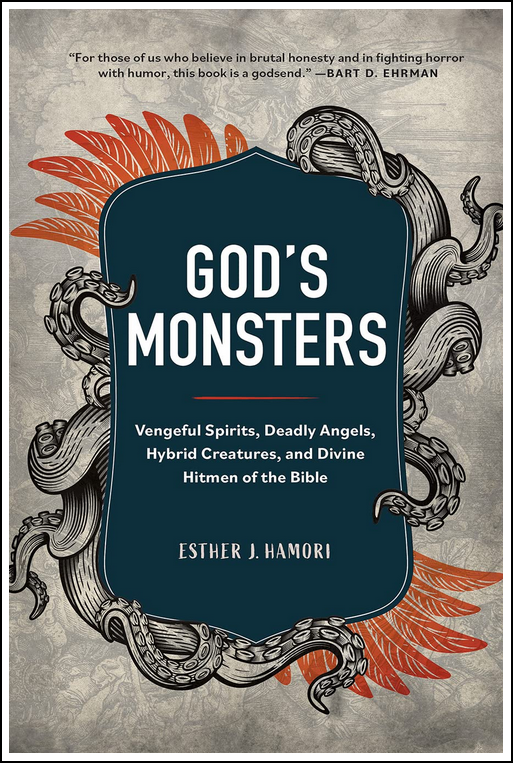
Ever wonder about all those Monsters in the Bible, and what they might tell us about, well, God? Earlier this year I read a book by Esther Hamori, God’s Monsters: Vengeful Spirits, Deadly Angels, Hybrid Creatures, and Divine Hitmen of the Bible. (Broadleaf Books, 2023). It’s been a long time since I’ve read a book on the Bible completely unlike anything I’ve read before. I thought it was fantastic (so to say). And so I did three things right off the bat. I agree to write a blurb for the book (see below); I met Esther (Professor of Hebrew Bible at Union Theological Seminary); and I asked her if she’d be willing to co-author the third edition of my textbook on the Bible. (She agreed). Here is the blurb I wrote for her book. God’s Monsters is a hilarious treatment of a horrifying topic. With deep intelligence, literary flair, and wicked wit, Esther Hamori pulls no punches in exposing the terrors of the Bible and the multitudinous divine creatures that inhabit it – including the […]
December 17, 2023
Hark, the Herald Angels What Now? Guest Post by Esther J. Hamori
Yesterday’s guest post by Hebrew Bible scholar Esther Hamori began to discuss her new book on the MONSTERS of the Bible and God’s, well, uncomfortably relationship with them. Today she continues by giving us a revised excerpt from the book itself: God’s Monsters: Vengeful Spirits, Deadly Angels, Hybrid Creatures, and Divine Hitmen of the Bible.. Now this will make you think… Esther J. Hamori is Professor of Hebrew Bible at Union Theological Seminary in New York City. You can get her book at this link, and I recommend you do! God’s Monsters. ****************************** If you know one angel by name, it’s got to be Gabriel. As a Jewish kid with no personal connection to Christianity but seemingly a thousand school Christmas pageants behind me by the eighth grade, I knew Gabriel as well as I knew Superman. Or at least, I thought I did. As Luke tells it, God sends Gabriel to tell Mary that she’ll give birth to Jesus. After the baby is born, an unnamed angel appears to a group of shepherds. Luke describes […]
December 19, 2023
Did Nazareth Even Exist?
I’ve been thinking and talking about the town of Nazareth a lot lately. ‘Tis the season! Last weekend I did my quarterly webinar with Platinum blog members (you should look at the benefits of the Platinum level! Private webinars!) on whether Jesus was actually born in Nazareth (most of the New Testament appears to thing so). And that made me think of an even more radical view that I think is dead wrong. Many of you will know about the vocal group of non-believers called “mythicists,” who think that Jesus never existed at all, but was completely fabricated, a complete myth. No man Jesus. Invented wholesale. I wrote a book years ago trying to explain why that almost certainly just ain’t true. A lot of mythicists were pretty ticked off about my book and I received some rather venomous responses. But hey, what’s life without a little spice? In this case, sliced habeneros straight on the tongue…. In any event, some mythicists argue as evidence for the non-existence of Jesus the non-existence of the town […]
December 21, 2023
Nazareth in the Time of Jesus: the Archaeological Record
I have been talking about the question (which I bet never occurred to you before!) of whether there actually ever *was* a Nazareth in the days of Jesus. Many “mythicists” who deny that Jesus existed use as part of their argument that Nazareth itself was made up. I’ve discussed this view over two posts to show how the arguments are highly problematic, in particular those mounted by Reneé Salm based on what he claims are archaeological facts. Here I continue by showing what the archaeologists themselves have had to say about it. This too is taken from my 2012 book Did Jesus Exist: The Historical Argument for Jesus of Nazareth. ****************************** There is an even bigger problem however with Salms’s view, however. There are numerous compelling pieces of archaeological evidence that in fact Nazareth did exist in Jesus’ day, and that like other villages and towns in that part of Galilee, it was built on the hillside, near where the later rock-cut kokh tombs were built. For one thing, archaeologists have excavated a […]
December 27, 2023
How Do You Translate the Bible? My Work for the New Revised Standard Version Committee
About two or three times a month I get asked about translations of the Bible. Usually the questions are about which one I prefer (answer: The New Revised Standard Version, i.e. the NRSV, and also an annotated edition, such as the Harper Collins Study Bible, which gives brief introductions to each of the biblical books and notes at the bottom of the page for difficulty passages, a kind of mini-commentary). But sometimes a questioner wants to know about the process of biblical translation and what it entails. I’ve been interested in this question for, well, roughly 50 years, but my interest reached a peak in the early 1980s when, as a lowly graduate student, I got invited to be a secretarial assistant for the committee producing the NRSV. Years ago on the blog I talked about that over a series of posts, both what the translation entailed, what problems it (and every other translation committee or individual scholar) had to confront, what I did for the committee over the years, etc. (For the first post […]
December 28, 2023
Problems with Translating a Single Greek WORD
In my last post I began to talk about my involvement with the translation committee for the New Revised Standard Version. My Doktorvater, Bruce Metzger, was the chair of the committee and he asked me, during my graduate studies, to be one of the scribes for the Old Testament subcommittee. In that capacity I recorded all the votes that were taken by the translators for revisions of the text of the Revised Standard Version, in whichever subsection of the committee I was assigned to. Normally the subsection would have, maybe, five scholars on it. They would debate how to modify the text of the RSV, verse by verse, word by word; they would then take a vote by show of hands; and I would record their decision. This was an eye-opening experience for me. Bible translation (or the translation of any foreign-language work, for that matter) is an inordinately complicated procedure. It is impossible to replicate the exact meaning of one language in another, since the nuances of words vary from one language to another. […]
December 30, 2023
Should Bible Translations Be Gender-Neutral?
More of my reflections from years ago about working with the New Revised Standard Version translation committee in the early 1980s. (With a few updates in brackets [ ]) One of the problems the committee had to address involved the use of gender-inclusive language. Part of the problem was that this issue was not a generally recognized issue (by the wider reading public) when the translators began their work, but was very much an issue when they were already finished with a large chunk of it. [And oh boy is it a big issue now…] The translators were mainly senior scholars who had acquired their linguistic skills before virtually anyone in the academy knew (or at least said) that there even was a problem with inclusivity, and so they themselves were learning how to communicate in the new idiom. And it took a while before they figured out how exactly to handle it. I myself was first introduced to the problem when I entered graduate school, and like a lot of people from my generation […]
December 31, 2023
The Gift of Christmas (2023)
The practice of gift-giving has obviously gotten way out of control for many of us in the Christmas season. I suppose on the upside, it helps the economy and gets more people employed, so that part’s good. But the commercialism and greed, not to mention the sense of heavy obligation (all those relatives!), uncertainty (O God, what am I going to get her this year?), and anxiety (I’ve only got three days left!), take a bit of an edge off of what is supposed to be a good thing: giving to the people we love to show we care for them and want them to know it. So for me, at least, the principle of gift-giving this time of year is something to be cherished. It is rooted ultimately in the Christmas story. But there is one aspect of the story – possibly the most significant aspect – that many people have never considered – one that nevertheless lies at its core. At heart it is the story of God’s giving his Son and his […]
December 24, 2023
A Blog Challenge Grant, A Worthy Cause for Your End-of-the-Year Giving
Many of us are (still!) considering some end-of-the-year giving as the End Draweth Nigh. As it turns out, an unusual option and opportunity has just appeared for the blog. An anonymous donor has pledged a matching $10,000 gift for all funds donated prior to the Happy New Year. The donor will match donations up to that amount — which would (if my math skills are still intact) be a very nice end of the year climax of $20k. All of the monies, of course, will go directly to the charities we support (if you don’t remember what those are, see this post: What Charities does the Blog Support? [I’ll be updating the numbers in a few days]). Not a penny will go to overhead — it all will go to those in need, a frustratingly increasing number, as we all know, given our current international crises and ongoing problems here at home. Are you interested? Any amount would be so welcome and so well-used. Donate simply by going to the blog, scrolling to the bottom […]
December 26, 2023
A Sensible Approach to Inclusive Language in Bible Translation?
The policy of the NRSV translation committee on inclusive language, as I began to discuss in the preceding post, was sensible, in my view. It involved a three-pronged approach. Any passage that was referring to both men and women was to be rendered inclusively, even if the original language (Hebrew or Greek) used masculine terms (“men,” “man,” “brothers,” “he” etc.). Any passage that was explicitly referring only to men, or only to women, was to be left as referring only to men or to women. All references to the Deity that in the original used masculine terms were to be left masculine. Here I will say a few things about each of these policies, in reverse order. First, the deity. No one on the committee thought that the deity actually has male genitalia or other sexual distinctions. But changing every reference to God (a masculine term, since there is a feminine alternative: Goddess) or Lord (again, a feminine alternative: Lady) or … anything else, would be hugely cumbersome and distracting. And there are not literarily […]
January 2, 2024
How to Botch a Bible Translation (because of inclusive language)
This post explains one of the real faux pas of the NRSV Bible translation, which, I regret to say, was not corrected in the new “updated edition.” It involves an unfortunate attempt to use inclusive language where it is misleading, and in this case, makes almost nonsense of the passage in question. But it’s a very tricky issue. It involves a quotation of an Old Testament Psalm in the New Testament, where the Old Testament passage is understandably rendered inclusively to include both men and women, but where its citation in the New Testament makes no sense when rendered inclusively. It appears to be a problem that the translators of both the original NRSV and of the updated version didn’t notice or, at least in my judgment, take seriously enough.
January 3, 2024
How Do We Fit in the Universe?
Yesterday I put out a post that involved Psalm 8, one of the great passages of the Old Testament. And I remembered that I posted a reflection on it many years ago, since it had made me think about something, well, rather significant: where we (I) fit into the universe. OK then! I’ve decided to come back to it here, because it still sometimes reflects in my head. Here is the psalm
January 4, 2024
My (Backstage) Work for the New Revised Standard Version Translation
Here I continue some of my discussion of my involvement with the New Revised Standard Translation, not as one of the translators (I was still a graduate student) but as a behind the scenes helper and research grunt. I start this post with a bit of autobiography and end with issues of translations. I have mentioned that I started out as a “secretary” for the committee when they were meeting twice a year to make decisions for the new translation, recording the decisions they made for changing the older Revised Standard Version translation. I did that for several years until they had finished their translation. I graduated from my PhD program in 1985, and I was already, at that point, teaching at Rutgers University. My position at Rutgers was a rather precarious one, professionally. In the language almost universally used today, I was an “adjunct” instructor, that is, a temporary faculty member without full (or much of any) benefits and paid as part time, even though I was teaching the full load of courses (with […]
January 6, 2024