Sorting by

×

The Year in Review: 2025!

Here on the last day of 2025 it is time to write my annual Blog-Year-in-Review post.  This year I have been helped considerably in the task by our fantastically gifted and efficient CEO, Jen (Olmos), whom many of you have had contact with over the course of your (and her) time with us.  Jen has been the greatest gift to the blog since we started in 2012, and has eased my workload significantly.  Among a zillion other things, she dug out all the data for me and has summarized our most important accomplishments.  As you’ll see, well done us! As y’all know, over the course of its thirteen years the Blog has had two major objectives, to spread knowledge of biblical (and related scholarship) more broadly among non-scholars and to raise money for charity doing it.  I’m more or less responsible for the scholarship and all YOU, the paying members and donors, are responsible for the funds, and Jen and our generous team of volunteers makes it all happen and keeps it all running. [...]

2026-01-04T16:18:37-05:00December 31st, 2025|Public Forum|

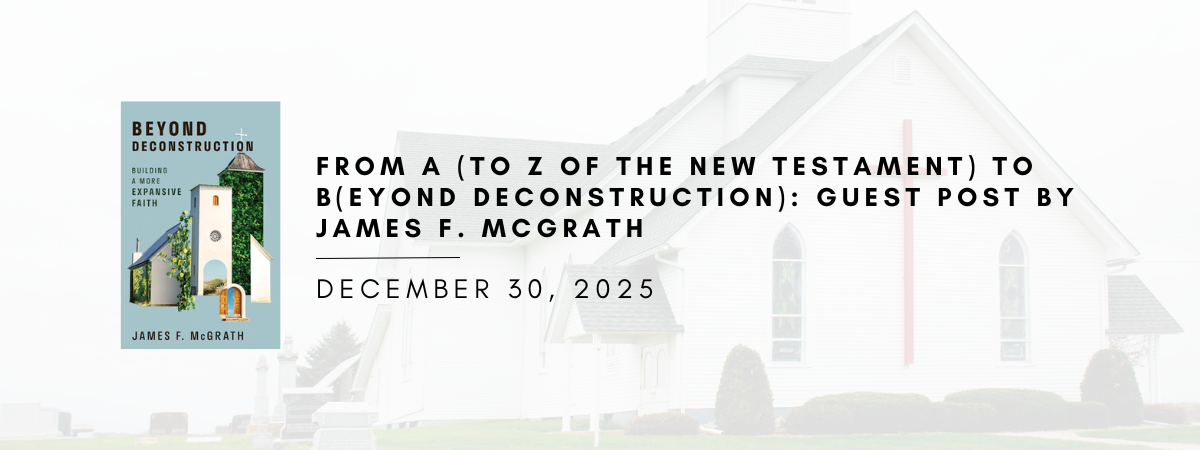
From A (to Z of the New Testament) to B(eyond Deconstruction): Guest Post by James F. McGrath

Here now is the final installment of James McGrath's series of posts on his book, in which he shows how the kind of knowledge experts on the New Testament have can affect those who are questioning their faith or have left the faith, which people these days often refer to as "deconstruction."  This issue of deconstruction is the topic of another now-forthcoming book of his that will be appearing soon.  Here is what he has to say about it. ****************************** There is a natural connection between the first book I wrote that was published by Eerdmans, The A to Z of the New Testament, and the most recent, Beyond Deconstruction, due out in early February. The term “deconstruction” has become the popular term for what happens when you start taking a close look at elements of your worldview, especially as a Christian, and find that there are elements of it that you can no longer subscribe to. For some it is a thoughtful investigation and careful selective replacement of beliefs and values. For others, it [...]

2025-12-29T21:23:58-05:00December 30th, 2025|History of Biblical Scholarship|

Alphabet Soup of the New Testament: Guest Post by James F. McGrath

Here now is the second guest post of James McGrath on his book that provides an introduction to New Testament scholarship for people who are not, will not be, and possibly never would dream of being New Testament scholars.  The full title and subtitle give a great sense of what it is all about:  The A to Z of the New Testament: Things Experts Know That Everyone Else Should Too. Here now is his fuller explanation. ****************************** For much of the time that I was working on The A to Z of the New Testament, the title was The ABCs of New Testament Study. I envisaged the cover having children’s blocks on it, or perhaps the title of the book spelled in alphabet soup. The folks at Eerdmans wisely went in a different direction with the cover. It was after running drafts of chapters by a couple of ministers at my church, each telling me that they learned things from it, that it became clear that I was doing more than just [...]

2026-01-02T09:52:50-05:00December 28th, 2025|History of Biblical Scholarship|

The A-Z of the New Testament: Guest Post by James McGrath

Bart:  I often get asked if there is some kind of simple guide to what scholars say about the New Testament, something that is competent, by an expert, but expressly for lay folk who want to know the most important findings of scholarship.  A couple of years ago James McGrath published a book that is just that kind of thing, and I realized, it's "bloody well time" (as they say in England) for us to have some posts about it.  James has kindly agreed to provide them. James is the Clarence L. Goodwin Chair in New Testament Language and Literature at Butler University, and occasional guest-poster on the blog.   Here is his first post of three. ****************************** Among the things that Bart Ehrman and I share in common is that we both care deeply about informing a general public about biblical scholarship. About 10 years ago, around the same time that his blog was really taking off, I was getting into my groove making silly parody song videos, often [...]

2026-01-02T09:52:10-05:00December 27th, 2025|History of Biblical Scholarship|

January 2026 Gold Q&A Announcement

The New Year is just around the corner and that means we have another Gold Q&A on the horizon. Join Bart on Saturday January 10th at 3pm Eastern. He will be live on Zoom, answering your questions. Have a question you'd like him to answer? Send it to [email protected] by the end of the day Thursday January 8th. We only have an hour for questions, so please keep your question short and to-the-point! Zoom link to join on January 10th: https://us02web.zoom.us/j/86251389515?pwd=KpRKd44VglTacyqzD6diffygPNxlx8.1 Meeting ID: 862 5138 9515 Passcode: 816907 We hope to see you there!  

2025-12-26T07:55:59-05:00December 26th, 2025|Public Forum|

My Interview about Christmas with Nicholas Kristof (New York Times)

I had an interview with Nicholas Kristof, columnist for the New York Times, which appeared electronically this past Saturday.  It was based on my book Love Thy Stranger (coming out in March) with a focus on Christmas. These kinds of interviews are very frustrating because it is impossible to back up a single thing you say and if you say anything that needs backing up, it is just sitting there for someone to take a potshot at.  Or at least when given as a bare statement seems really dubious.  But, it's the nature of the beast (kind of like being interviewed as a talking head for a documentary film/TV show; they interview you for three hours  and then take ten or fifteen ten- or fifteen-second soundbites!) So many of the comments the (NYT) interview has received show how many people in the world who have opinions about the Bible, Jesus, and early Christianity would really benefit from learning more.  There are so many commonplaces out there that simply seem true to people because they've heard [...]

2025-12-22T11:02:27-05:00December 25th, 2025|Public Forum|

Pubs and Churches on Christmas Eve

Some years ago Sarah and I were in England celebrating Christmas with her brother in Saffron-Walden, a market town just south of Cambridge.  After a lovely Christmas eve dinner, Sarah decided she wanted to go to the midnight service at the local Anglican Church.  We, both of us agnostics, decided to go with her. I had always had a soft spot for Christmas eve services.  All the way through high school in Lawrence Kansas I had served as an acolyte in the Episcopal church, which held a very moving candlelight service that I always regarded as the most deeply profound service of the year.  But I hadn’t been to a service in years and thought I would really like to go. As we were walking through the streets to the service we passed a number of pubs packed mainly with young folk.  Religion has not fared will in England for years now, and the idea of going to a Christmas Eve service (let alone a regular ole Sunday service) is the farthest thing [...]

2025-12-22T10:59:06-05:00December 24th, 2025|Reflections and Ruminations|

Reflecting on the Christmas Tree and Faith

One of my favorite parts of Christmas for most of my life was the tree.  I’m not sure why exactly.  When I was a kid we had those old bubble lights, and I found them fascinating.  I loved sitting in the dark room by myself just looking at them – something like sitting in front of a fire and watching it burn, thinking deep thoughts.  Well, as deep as thoughts can be for a 10-15 year old.  I don’t recall any content, just the deep quiet satisfied feeling of peace. The first Christmas I was married, in 1977, my wife and I were living in a tiny apartment in Oak Lawn Illinois, where I was a youth pastor at an Evangelical Covenant Church (and a senior at Wheaton College).  There really wasn’t much room for a tree, but we were bound and determined to get one.  It was a very cold winter, with snow, and the nearest Christmas tree lot had trees that were bundled shut and frozen, making impossible to see how good it [...]

2025-12-22T10:53:03-05:00December 23rd, 2025|Reflections and Ruminations|

Comics from My Office Door

Here are some of my favorite comics -- pinned to my office door for many years. I've just moved out of it -- I've had it for 37 years!  And these were the last things to take down.  I've always especially like the last one here. De-Parting is such sweet sorrow...  

2025-12-22T05:55:34-05:00December 21st, 2025|Public Forum|

Light Cast on the Formation of the Christian Canon in Polycarp’s Short Letter

Polycarp’s letter to the Philippians, which I began discussing yesterday, consists largely of general moral exhortations. The Philippians are to love one another and to pray for one another and to give alms whenever possible; their wives are to love their husbands and to educate their children in the fear of God; their widows are to be discreet and devoted to prayer; their deacons are to be moral and upright; their younger men are to avoid passions of the flesh; and so on. Many readers of the letter have found these guidelines somewhat uninspiring, or at least uncreative. Indeed, Polycarp devotes almost the entire letter to quoting or alluding to other early Christian authorities. Rather than formulating views of his own, he has produced a kind of pastiche of earlier traditions. To get an idea of just how thoroughly immersed Polycarp was in Christian writings produced earlier, consider the following passage drawn from the fifth chapter of his letter to the Philippians. I have placed possible echoes and citations of earlier Christian writings [...]

2025-12-16T20:51:47-05:00December 20th, 2025|Early Christian Writings (100-400 CE)|

The Letter of Polycarp to the Philippians (Another Apostolic Father) in a Nutshell

The next “Apostolic Father” we will consider is Polycarp, Bishop of Smyrna, a friend of Ignatius, who like him came to be martyred on account of his Christian faith (see chapter 26), Polycarp was himself the recipient of one of the surviving letters of Ignatius around 110 c.e., some forty-five years or so before his own death. Soon after he received this letter, he wrote to the Philippian Christians, evidently in response to their requests on several matters (Pol. Phil. 3:1). Here is what I say about him and his writing in my textbook, The New Testament: A Historical Introduction to the Early Christian Writings (Oxford University Press). **************************** The Philippians had requested from Polycarp a copy of “the letters of Ignatius, including both those he sent to us [in Smyrna] and any others which we had by us” (13:2). Polycarp complied with this request, sending his own epistle as a kind of cover letter for the collection. Polycarp indicates that both Ignatius and the Philippians had requested that he, or one of [...]

2025-12-16T20:46:53-05:00December 18th, 2025|Early Christian Writings (100-400 CE)|

A Bizarre Scandal Involving the Dead Sea Scrolls

Years ago I published a blog post about a scandal involving the Dead sea scrolls.  I had forgotten all about it, but ran across it today and thought it would be an interesting re-post.  It involved a court case and jail time!   Here's what I said: ****************************** A few years ago I was asked to give a speech at a museum in Raleigh NC in connection with an exhibit of the Dead Sea Scrolls that had been long in the works and had finally become a reality. I will be the first to admit, I'm not the first person you should think of to give a lecture on the Dead Sea Scrolls. It’s not my field of scholarship. But the lecture was to be one of a series of lectures, and the other lecturers actually were experts, including my colleague Jodi Magness, a world-class archaeologist who happens to teach in my department (well, she doesn’t “happen” to teach there; we hired her when I was chair of the department) and who has written the best [...]

2025-12-16T11:22:11-05:00December 17th, 2025|Early Judaism, Religion in the News|

Was Jesus a Member of the Dead Sea Scroll Community (the Essenes)?

In my previous post I talked about the significance of the Dead Sea Scrolls for understanding Jesus and the milieu out of which earliest Christianity grew.  My basic point is that if Jesus was a Jew, then to understand him, you have to understand Jews in his world.  And the Dead Sea Scrolls provide us valuable information to that end. I am not saying that the Dead Sea Scrolls are representative of what all or even most Jews thought at the time.  They clearly are not.  If the “Essene hypothesis” is right (that is, that the Scrolls were produced by members of a Jewish sect known as the Essenes) – and it is the view held by the vast majority of the experts (I am *not* an expert on the Scrolls) – then the Scrolls were produced by a Jewish sect that had very distinctive views of its own that were not, in many respects, shared by outsiders.  In particular, this was a group of Jews who insisted that the coming apocalyptic judgment, soon to [...]

2025-12-16T11:01:45-05:00December 16th, 2025|Early Judaism, Historical Jesus|

Why Do the Dead Sea Scrolls Matter for Understanding Jesus?

Many people assume that somehow or other the Dead Sea Scrolls matter for understanding better who Jesus was and what he preached.  But how?  In this post I'll give a fairly succinct answer to the question. I should begin by stressing that the Scrolls are *mainly* important for understanding early Judaism, and only secondarily for understanding early Christianity. Even so, they are highly important for Christianity as well, though not in ways you might suspect (especially if you acquire all your historical knowledge from random searches on the Internet!).  If I were to do the one-sentence version of why they matter for understanding Christianity, the shortest iteration I can come up with is that:  "The Dead Sea Scrolls are texts written and/or copied by Jews living at about that same time and about the same place as Jesus, and so inform us about the milieu out of which his ministry, and the earliest Christian church, emerged." The first thing to stress is that the Scrolls are thoroughly Jewish in every sense.  There is [...]

2025-12-16T10:55:09-05:00December 14th, 2025|Early Judaism, Historical Jesus|

What Are the Dead Sea Scrolls? The Basics

I gave a lecture the other day in which I mentioned the Dead Sea Scrolls.  This morning, when looking back over the blog, I realized I haven't really said much about them for ... years!  So, here are some of the basics you can pull out when things get dull at your next cocktail party. Even though just about every thinking human being in our context has heard of the Dead Sea Scrolls, most have no clue what the scrolls are, what they contain, and how they were found.  It's no surprise they've at least heard of them.  The Dead Sea Scrolls are by virtual consensus the most significant manuscript discovery of the twentieth century, of major importance for understanding Judaism at the time of Jesus and, in some respects, the teachings of Jesus himself. Here is what I say about the scrolls in my New Testament textbook (Oxford University Press: The New Testament:  A Historical and Literary Introduction).  I begin by talking about the Jewish group widely thought to have been responsible for producing, using, [...]

2025-12-16T10:49:43-05:00December 13th, 2025|Early Judaism|

My Birdbrain View of Agnosticism

Yesterday I shared one of the thoughts that crept into and dominated my mind for a few minutes while watching a glorious sunrise from the comforts of a nice chair in front of a big window while drinking a cup of coffee.  Here now is my second. We have some bird feeders out on the deck and I was watching not only the dawning of the day but also the birds coming out to break their fast.  Chickadees, Titmice, and Juncos for the most part.  They love the seed. And it occurred to me: these birds have no idea of my existence.  If I moved toward them they would instinctively fly away, so they do recognize the reality of threat.  But do they understand that I’m a human, that I have a mind with thoughts and organs and limbs that make me function, that I have the abilities to analyze and reason, that I have a career and possessions, that I think about lots of issues both academic and quotidian.  Do they have any conception [...]

2025-12-16T10:46:25-05:00December 11th, 2025|Reflections and Ruminations|

If It Is All Matter, Why Should It Matter?

On Saturday I was sitting in a comfortable chair in front of a large window with a nice cup of coffee watching the sun slowly rise.  I was in a contemplative mood, not dwelling on the quotidian duties bound to occupy me in the hours ahead, but thinking about some of the Big Issues in life, or at least in my life. I had two thoughts that I’d like to pass along.  At the time I wondered if they were possibly, but not necessarily, standing at odds with each other.  If so, so be it! The first had to do with the world all around and before me at the time.  The sunrise was glorious as the earth rotated and the sky slowly brightened, mixing colors in the scattered clouds above.  I started thinking both bout how amazing the natural world is and about how, at the end of the day, I think that all of it – every aspect of it – consists of material elements. At heart I’m a materialist.  [...]

2025-12-16T10:42:07-05:00December 10th, 2025|Public Forum|

Some Key Passages from the Gospels: Questions from Readers

I've received some terrific questions about the Gospels recently; here is a good sample and my responses.   QUESTION: I have a question on the Gospel of John. This gospel describes Jesus as a pre-existing divine being (the Word) who became flesh. But it does not mention any virgin birth of a divinely sired baby. Without the virgin birth, how did John imagine the incarnation to have happened? Did Jesus simply materialize in the world as a baby? Or as a full-grown man? What can we know about this? RESPONSE: Ah, good question. Actually John's view of incarnation is at odds with the idea of Virgin Birth, even though Christians have long conflated the two by saying the line in the Creed:  "He became incarnate through the Virgin Mary." When you read the Virgin Birth narratives of Luke, it indicates that Jesus became the son of God at and because of his conception:  “The Holy Spirit will come upon you SO THAT the one born of you will be called holy, the Son [...]

2025-12-16T10:39:32-05:00December 9th, 2025|Canonical Gospels, Reader’s Questions|

A Heart-Rending Story and Stunning Condemnation: The Prophet Hosea

Most of the so-called “minor prophets” (called that because their books are shorter than those of Isaiah, Jeremiah, and Ezekiel) are both terrific and terrifically under-read.  So I think maybe I should post a bit on each of them (there are twelve). (I started last week with Zechariah)  One of my favorites is Hosea, which tells a heart-wrenching story and delivers an unusually powerful message. The following is an edited version of my discussion in my book The Bible:  A Historical and Literary Introduction (Oxford University Press). ****************************** No prophet of scripture emphasizes the deep and profound love of God for his people, and his bitter sense of betrayal for their unfaithfulness, more than the eighth-century Hosea. Here God is portrayed as the lover of Israel, which has rejected his adoration and become a whore. Hosea was a contemporary of Amos and was prophesying in the north during almost the same time as Isaiah in the south during the reigns of kings Uzziah, Jotham, Ahaz, and Hezekiah of Judah and of Jeroboam [...]

2025-12-16T10:33:05-05:00December 7th, 2025|Hebrew Bible/Old Testament|

Ignatius: Eager to be Eaten by the Wild Beasts

In some respects, the most interesting of Ignatius’s writings is the letter to the Romans, where he deals explicitly with his upcoming martyrdom. We might expect that Ignatius would want to find some way to avoid having to pay the ultimate price for his faith, if he could do so without compromising his convictions. Ignatius, however, goes to his death eagerly, longingly. He writes to the Romans to urge them not to interfere, for he believes that only by suffering a glorious and bloody martyrdom will he become a true disciple of Christ, only by imitating Christ’s own Passion will he be able to “get to God.” Most of the surviving Christian writings from antiquity take a positive view of Christian martyrdom, urging Christians to go willingly to their deaths for the faith and to endure all the tortures that humans can devise. By doing so, Christians would imitate the Passion of their Lord, Jesus. [SIDENOTE: Not everyone agreed. We know from the letters of Pliny and the writings of several Christian authors, [...]

2025-12-02T15:42:10-05:00December 6th, 2025|Early Christian Writings (100-400 CE)|
Go to Top