Sorting by

×

About BDEhrman

Ehrman is the James A. Gray Distinguished Professor of Religious Studies at the University of North Carolina at Chapel Hill, where he has served as the director of graduate studies and chair of the Department of Religious Studies.

The Myth That Nazareth Was a Myth

Did Nazareth even exist in Jesus’ day? Or was it invented by the same ancient people who invented the man Jesus – a non-existent home for a non-existent person? So claim many of the “mythicists” I began to discuss in my previous post. Here I continue on the theme, as discussed in my book Did Jesus Exist? ****************************** G. A. Wells advances a different argument to much the same end. In his view the key to understanding the non-existence of Nazareth is in the four occasions in which Mark indicates that Jesus was a “Nazarene” (1:24; 10:47; 14:67; 16:6). According to Wells Mark misunderstood what this meant. What it originally meant was that Jesus belonged to a pre-Christian Jewish sect called the “Nazarenes” who were similar to figures from the Old Testament (like strong-man Samson) called Nazirites who took vows to be specially set apart for God (they couldn’t touch corpses, drink wine, or cut their hair). Mark didn’t know this, though, and wrongly assumed that the term Nazarene must have indicated Jesus’ place [...]

2025-09-10T13:05:41-04:00December 23rd, 2023|Public Forum|

Did Nazareth Even Exist?

I’ve been thinking and talking about the town of Nazareth a lot lately.  ‘Tis the season!  Last weekend I did my quarterly webinar with Platinum blog members (you should look at the benefits of the Platinum level!  Private webinars!) on whether Jesus was actually born in Nazareth (most of the New Testament appears to thing so).  And that made me think of an even more radical view that I think is dead wrong. Many of you will know about the vocal group of non-believers called “mythicists,” who think that Jesus never existed at all, but was completely fabricated, a complete myth.  No man Jesus.  Invented wholesale. I wrote a book years ago trying to explain why that almost certainly just ain’t true.  A lot of mythicists were pretty ticked off about my book and I received some rather venomous responses.  But hey, what’s life without a little spice?  In this case, sliced habeneros straight on the tongue…. In any event, some mythicists argue as evidence for the non-existence of Jesus the non-existence of the town [...]

2025-09-10T13:05:41-04:00December 21st, 2023|Historical Jesus, Mythicism, Public Forum|

Interpreting a Text to Make It Seem Orthodox: Luke and Its View of Jesus

In my previous post in this thread I tried to show how one way to show that a text that embraced a “problematic” view (e.g., a potentially heretical understanding of Jesus as an *adopted* son of God instead of, say, the *eternal* son of God) was by interpreting it in light of *other* texts that held more acceptable views.  I named an example in my previous post.  I end the thread here with this one. ****************************** A similar emphasis might be detected behind the entertaining stories of other infancy Gospels, including the one that is arguably the earliest, the Infancy Gospel of Thomas.  It’s true that later authors like Irenaeus found this set of tales distasteful and even heretical; according to Ireneaus (assuming that he was referring to our Infancy Thomas, which I think he was; Adv. Haer 1:20) this was a gnostic text that inappropriately emphasized Jesus’ gnosis at a young age, when confronting his teachers with supernatural knowledge.  But there’s little in the text itself actually to suggest a Gnostic origin.  In fact, [...]

2025-09-10T13:05:41-04:00December 20th, 2023|Canonical Gospels, Christian Apocrypha, Heresy and Orthodoxy|

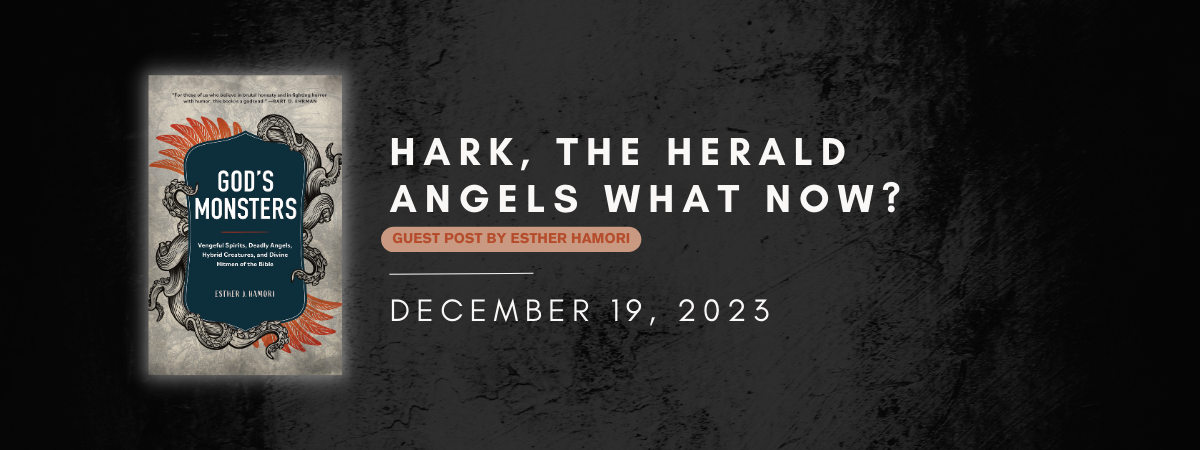
Hark, the Herald Angels What Now? Guest Post by Esther J. Hamori

Yesterday's guest post by Hebrew Bible scholar Esther Hamori began to discuss her new book on the MONSTERS of the Bible and God's, well, uncomfortably relationship with them.  Today she continues by giving us a revised excerpt from the book itself:  God’s Monsters: Vengeful Spirits, Deadly Angels, Hybrid Creatures, and Divine Hitmen of the Bible..  Now this will make you think... Esther J. Hamori is Professor of Hebrew Bible at Union Theological Seminary in New York City. You can get her book at this link, and I recommend you do!  God's Monsters. ******************************   If you know one angel by name, it’s got to be Gabriel. As a Jewish kid with no personal connection to Christianity but seemingly a thousand school Christmas pageants behind me by the eighth grade, I knew Gabriel as well as I knew Superman. Or at least, I thought I did. As Luke tells it, God sends Gabriel to tell Mary that she’ll give birth to Jesus. After the baby is born, an unnamed angel appears to a group of shepherds. Luke describes [...]

2025-09-10T13:05:41-04:00December 19th, 2023|Hebrew Bible/Old Testament, Revelation of John|

Biblical Monsters and Their Violent God! Guest Post by Esther Hamori

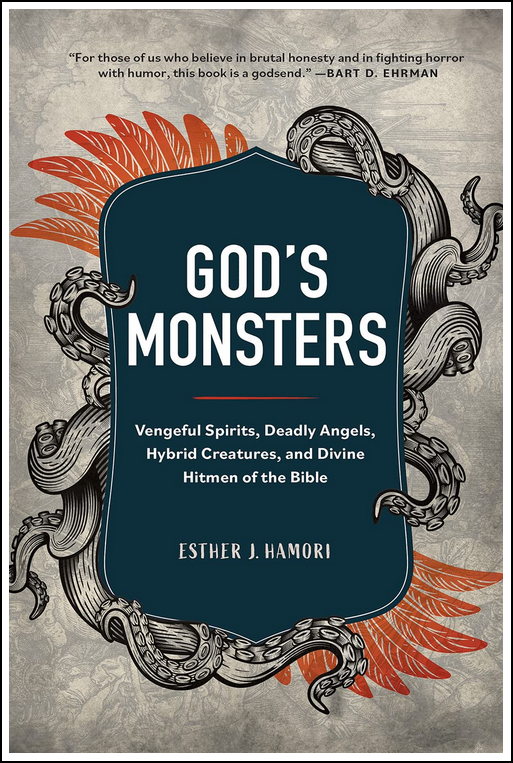
Ever wonder about all those Monsters in the Bible, and what they might tell us about, well, God?   Earlier this year I read a book by Esther Hamori, God’s Monsters: Vengeful Spirits, Deadly Angels, Hybrid Creatures, and Divine Hitmen of the Bible. (Broadleaf Books, 2023).  It's been a long time since I've read a book on the Bible completely unlike anything I've read before.  I thought it was fantastic (so to say). And so I did three things right off the bat.  I agree to write a blurb for the book (see below); I met Esther (Professor of Hebrew Bible at Union Theological Seminary); and I asked her if she'd be willing to co-author the third edition of my textbook on the Bible.  (She agreed). Here is the blurb I wrote for her book. God’s Monsters is a hilarious treatment of a horrifying topic.  With deep intelligence, literary flair, and wicked wit, Esther Hamori pulls no punches in exposing the terrors of the Bible and the multitudinous divine creatures that inhabit it – including the [...]

2025-09-10T13:05:41-04:00December 17th, 2023|Hebrew Bible/Old Testament|

How Did Early Christians Make Unorthodox Texts Seem Orthodox?

I’ve been arguing that Luke’s Gospel originally may not have had the story of Jesus’ virgin birth but portrayed Jesus as being adopted by God to be his son at the baptism.  In the previous post I explained one strategy that could be used to “tame” an otherwise important and beloved text when it held a view that could be seen as problematic.  You could edit it.  But there are other ways as I explain here (taken from a paper I delivered orally to a group of scholars) ****************************** A second strategy that could be used and was used by proto-orthodox Christians to constrain the reading of the text was by putting it in a canon of writings, a collection of texts with varying perspectives which, once placed together, affected how each one would be read. I’ll not spend much time discussing this strategy, as it is familiar enough to all of us here.  It was familiar enough to early Christians as well, as early as Irenaeus, who points out in a famous passage in [...]

Why Would an Editor ADD the Virgin Birth to Luke?

Is it possible that Luke's Gospel originally lacked the story of the Virgin Birth, but that it was added later in order to make the book more "orthodox"?  That's the question I'm pursing in this thread, based on a paper I delivered to a group of NT scholars 20 years ago. ****************************** It appears that in the earliest form of Luke’s Gospel, what we have is an account that locates Jesus’ adoption/appointment to sonship, and its accompanying empowerment, at the baptism, when God declared “Today I have begotten you.”   It is true that throughout the work of Luke - Acts there are other kinds of christological traditions preserved as well – especially in the speeches of Acts.  But many of these are also adoptionistic, even though they appear to embody an even earlier adoptionistic notion that it was at the resurrection, not the baptism, that God conferred a special status upon Jesus and invested him with a special power. At this point I should stress that I am not trying to give an [...]

No Virgin Birth? Was Jesus ADOPTED by God to be His Son?

Did Luke originally have the story of Jesus’ virgin birth? In my previous post I gave reasons for suspecting that Luke did not originally have chs. 1-2 (the birth narratives), but that it started (after what is now the preface in 1:1-4) with what is now 3:1. One of the reasons it is hard to know for certain is because we simply don’t have much hard evidence.  Our two earliest two manuscripts of Luke, P75 and P45, are lacking portions of Luke, including the first two chapters.  We can’t say whether they originally had them or not.  Our first manuscript with portions of the opening chapters is the third century P4.  But our earliest patristic witness is over a century earlier.  As it turns out, the witness is the heresiarch Marcion, and as is well known he didn’t have the first two chapters! As early as Irenaeus’s Adversus Haereses (1. 27. 2) Marcion was accused of excising the first two chapters of his Gospel because they did not coincide with his view that Jesus appeared [...]

Did Luke’s Gospel Originally Contain a Virgin Birth?

A couple of weeks I gave a two-lecture online course called “Jesus, The Actual Son of Joseph: The New Testament Evidence” (not connected with the blog; you can learn more about it on my website www.bartehrman.com/courses).  It was an interesting experience for me, in part because it made me think of things and look into things I hadn’t thought or looked into before, and in part because it made me look back at some of the work I had done before but not thought about in a long time. That included a paper that I gave twenty years ago now at the British New Testament Conference organized by Mark Goodacre, back when he was still teaching a the University of Birmingham in England.  For this more recent course I re-read the paper (not remembering it!) and (having read it again) thought that it would be interesting to excerpt here on the blog. It was delivered for scholars of the New Testament, but I wrote it so that it would not be overly technical or jargony, [...]

When Modern Christians Came to Think “The End is Near”

Israel and Palestinians: in my previous post I began to explain why Christians in Britain and America (some of them highly influential on foreign policy in both places) came to support the re-establishment of the state of Israel in the early 19th century.  I pick up the discussion there, with another excerpt from my book Armageddon: What the Bible Really Says About the End (Simon & Schuster, 2023).  This one too veers into a direction I imagine you won’t expect. ****************************** For years evangelical Christians had been convinced that Scripture predicted Jews were to return to the Holy Land to reestablish themselves there as a sovereign state.  After all, the Old Testament prophet Jeremiah had reported God’s words to his people Judah: “I will restore your fortunes and gather you from all the nations and all the places where I have driven you … and I will bring you back to the place from which I sent you to exile” (Jeremiah 29:14).  If the end was near, as indicated by the events in France, then the [...]

2025-09-10T13:05:28-04:00December 10th, 2023|Religion in the News, Revelation of John|

American Support of Israel: A (Widely) Unknown Part of the History

Since the horrific sequence of events that started on October 7, I have been asked about the historical roots of the conflict.  Much of the important information is well known and easily accessible, from the biblical accounts of the Conquest of the Promised Land, up through 1948, on to the Second Intifada, till today.  I won’t be covering this information here, and I will not be offering my political or personal opinions on the matter.  I will instead provide some important and widely unknown historical information on one of the significant aspects of the matter. In a section of my book Armageddon: What the Bible Really Says About the End, published earlier this past year, I discussed how the expectation that “The End is Near,” largely based on interpretations of the book of Revelation, came to affect broad swaths of American culture in ways that almost no one would suspect.  I should say emphatically that I’m not one of those religion scholars who thinks religion is at the heart of everything.  But it is at [...]

2025-09-10T13:05:28-04:00December 9th, 2023|Religion in the News, Revelation of John|

Jesus in Illuminated Manuscripts and Legends: Video Post

Here's something I've dug out of the archives! I was asked to speak at the Getty Museum, in the Harold M. Williams Auditorium in Los Angeles, California on Thursday, September 22, 2011 during the exhibition "In the Beginning Was the Word: Medieval Gospel Illumination." Illuminated manuscripts from the Middle Ages are significant for the literary texts they preserve. But they are also important, historically and culturally, for their illustrations of the life of Jesus and other figures associated with him.   These artistic representations tell tales of their own, and the visual stories are not always found in the corresponding texts. A careful examination of these images shows clearly and convincingly that medieval artists were familiar not only with the stories of the canonical Gospels but also with many noncanonical apocryphal tales of Jesus. The apocryphal stories, in some instances, were understood to be "Gospel truth" on par with accounts found in Scripture. In any event, here is the lecture that I gave: Please adjust gear icon for 720p High-Definition: Details on the "In [...]

2025-09-10T13:05:28-04:00December 7th, 2023|Christian Apocrypha, Public Forum, Video Media|

So: Did Anyone Think of Jesus as a Miracle-Worker Before His Crucifixion?

This is the final, and most important, of my posts on the miracles of Jesus.  In it I raise the question – without being able to come to an absolutely definitive answer – of whether Jesus was thought to be a miracle worker already in his life time or if, instead, miracles came to be ascribed to him only later by followers who believed he had been raised from the dead.  I incline toward the latter view. To set the stage for and make sense of what I have to say, I include the final comments from the previous post: ****************************** In the other two Synoptics there is a different understanding, one that can be seen most clearly in the saying preserved in Matthew 11:2-6.  Here we are told that John the Baptist, who is now in prison, has heard about “the deeds of Christ,” and sends some of his disciples to him to ask if he is the one to come at the end of time, or if there is someone else.  Jesus replies:  [...]

2025-09-10T13:05:28-04:00December 6th, 2023|Historical Jesus|

Platinum Webinar for December: “O Little Town of Nazareth? Where Was Jesus Actually Born?”

Dear Platinum Members, It's time for our Quarterly Platinum Webinar.  We have scheduled it for Thursday, December 14, 2023, at 7:30 pm. I've decided to go with a seasonal topic on an aspect of the Gospel birth narratives that most people have not much thought about:  could "Jesus of Nazareth" have actually been born in Nazareth, instead of Bethlehem?  Scholars have long argued so.  But on what grounds? I'll explain in my talk, we'll have questions and discussion, and then you can decide for yourself.  Hey, it's a free world!  Here's the link: https://us06web.zoom.us/j/85895014121?pwd=d4YeabuDx7s5A5LTzXse3C4wQgebwV.1 I hope to see you there. Bart

2025-09-10T13:05:41-04:00December 5th, 2023|Public Forum|

What’s the *Point* of Jesus’ Miracles?

I have been talking about the stories of Jesus' miracles, and am raising the question of whether they necessarily go all the way back to Jesus' lifetime, as tales told while he was still living.  I pick up where I left off last time, after showing that Jesus' miracle-working abilities increased with the passing of time. ****************************** Not only does Jesus become increasingly miraculous with the passing of time, these miracles are all told in order to make a point.  The stories about Jesus as the miraculous Wunderkind reveal that he really was the Son of God endowed with supernatural power straight from the womb; as a five-year old he was already the Lord of life and death; as the resurrected savior he was manifestly a superhuman being of giant proportions.  In more general terms, the miracles in our later accounts repeatedly show that Jesus was the spectacular Son of God.  He was far superior to all his enemies (even if these were only the aggravating kids down the street).  He was more powerful than [...]

2025-09-10T13:05:28-04:00December 5th, 2023|Historical Jesus|

Was Jesus Considered a Miracle Worker During His *Lifetime*?

In my discussion of whether the historian can deal with the category of miracle, I’m now at the point where I can deal directly with the miracles ascribed to Jesus.  This is an issue that I have dealt with in several books, including, most recently, Jesus Before the Gospels.   It will take three posts for me to cover the waterfront here.  This is how I began dealing with the issue in the book. ****************************** The Miracles of Jesus When one discusses the activities and deeds of Jesus, it is very hard indeed to avoid talking about his miracles.  Miracles are everywhere in the Gospel accounts of Jesus’ life.  He is miraculously born to a woman who has never had sexual relations.  From the beginning of his public ministry to the end he does one miracle after the other, conquering nature, healing the sick, casting out demons, and raising the dead.  So abundantly attested are Jesus’ miracle-working abilities that even scholars who are otherwise skeptical of the supernatural biases of our sources sometimes [...]

2025-09-10T13:05:28-04:00December 3rd, 2023|Historical Jesus, Public Forum|

Gold Q&A!! Ask Your Questions!

Hey Goldies and Plats, Now's your chance!  I'll be recording the December Gold Q&A on December 11, schedule gods willing, to be published later that week.  God a burning, a smoldering, or a cool ?  Ask away!  Anything related to the blog.   I'll do my best to answer.  , Send your questions to [email protected], and Diane will compile and send me the list. DEADLINE: Get your question in by Saturday (12/09/2023) midnight (whenever midnight is in your time zone). Every question I get is interesting, but remember that shorter and to-the-pointer questions are more likely to be chosen.  Zingers are welcome!

2025-09-10T13:05:40-04:00December 2nd, 2023|Public Forum|

Were Jesus’ Miracles in the Original Texts of the Gospels?

Here's an interesting question I received from a reader many years ago that I had forgotten all about, but I bet it's one some others have had (If you know the "Jefferson Bible" you'll see it has a long history of sorts): QUESTION: I have looked up the content of all the papyri of the New Testament I'm aware of (i.e. the most ancient manuscripts) . It is my understanding that although p52, p90, and p104 are dated around 125-150 AD, they contain fragments of John 18 and Matt 21 only, and that it's not until 200 AD that manuscripts emerge which actually contain accounts of supernatural actions by Jesus. So, it's possible that accounts of miracles existed in copies that got destroyed, but is it fair to say that the earliest available copies of accounts of Jesus's supernatural actions date from around 200 AD? In other words, assuming people on average had kids by age 20 back then, and thus 20 years counts as a generation, is it fair to say that the earliest available accounts [...]

2025-09-10T13:05:28-04:00December 2nd, 2023|Public Forum|

I’m Lecturing on a Cruise this Summer. Interested in coming?

Everyone is traveling these days.  I’m traveling these days.  Hey, wanna travel with me? This summer I’m doing a tour (and giving lectures) on a cruise to historic coastal cities and religious sites of Western Europe, from Amsterdam to Lisbon, July 30 - August 10.  This is gonna be an unusually good trip, with awe-inspiring scenery, gorgeous medieval towns/cities, important religious sites (including Santiago de Compostela), and some of the most amazing museums in the known universe. Included on the tour are some of my all-time favorite cities:  Amsterdam, Bruges, and Lisbon.  And it includes a bunch of places I’ve never seen but always wanted to, Honfleur (Normandy Beaches), St. Malo (Mont St-Michel), Tresco (Isles of Scilly off the coast of Cornwall; I’ve been to Cornwall a ton, but never the Isles), Concarneus, France (Brittany!), Santiago de Compostela (whoa…), Oporto Portugal.  How good can it get? The cruise is being organized / run by Thalassa Journeys, best known for their small-group educational tours for university groups.  In this case the small group is not college [...]

2025-09-10T13:05:40-04:00December 1st, 2023|Public Forum|

Is There Any Sarcasm in the New Testament?

Every now and then someone asks me if there is any sarcasm used in the New Testament.  You would think the answer would be fairly obviously, No.  But, well, I've dealt with the issue before, and my response was Yes. Let me start by giving a definition of sarcasm.  You can find various definitions just on the Internet, but the basic idea is that sarcasm is a form of humor that used irony in order to mock another. It is difficult to identify sarcasm in ancient writings.  In fact, as you’ve probably noticed, sometimes it’s hard to know if someone is being sarcastic when they are speaking directly to our face.  The way we typically detect sarcasm is by the context of the comment and the non-verbal signs given – the facial expression, for example, or the tone of voice used and the words orally emphasized.  You have none of that for the writings of the New Testament – only a bit of information about context (inferred from the text itself) and no non-verbal signs.  [...]

2025-09-10T13:05:28-04:00November 29th, 2023|Paul and His Letters, Reflections and Ruminations|
Go to Top