
Search
Advanced search
Redaction Criticism of the Gospels
In a previous post I explained why scholars have long held to “Markan Priority,” the view that Mark was the first Gospel written and that Matthew and Luke both used it for constructing their own narratives. One great pay-off for this conclusion (it really is significant) is that it is possible, given this result, to see how Matthew and Luke have each *modified* Mark in the stories they received from him. This approach is called “redaction criticism.” A “redactor” is an editor. Redaction criticism looks at the editing decisions made by an editor of a source. Years ago I described the method and gave an illustration of how it worked on the blog, in part to show that finding the differences between the Gospels is not necessarily a *negative* thing, but can have very *positive* results for interpreting the message each one has. This is what I said then: ********************************************************************* I have stressed that knowing that there are differences, even discrepancies, among the Gospels does not need to be considered in a purely negative […]
Tags: redaction criticism
December 1, 2017
Last Minute: Dinner on Thursday?
I will be having dinner with several blog members this Thursday in Durham NC, my home turf. We have had a cancellation, and so there is one more open spot at the table. If anyone is interested in coming, please contact me at [email protected] There are no obligations other than showing up, paying for your dinner, and talking about whatever suits your fancy for a couple of hours!
December 2, 2017
Could Q Have Been Lost? Readers’ Mailbag December 3, 2017
I have received a lot of questions about Q this week. If you’re wondering about why blog members are interested in a figure from Star Trek, you may want to review this week’s posts. Here is a question that I find particularly intriguing. QUESTION: It is hard to believe that Q, if it existed, circulated enough to be used by both but then dropped off the face of the Earth without so much as a mention by an early church father, while references to so many other documents survived (with some being found). RESPONSE: Ah, this is an interesting observation and involves a set of questions that I’m very interested in but have never published (much of) anything about. How much of the early Christian literature was lost? Could early Christians simply have allowed important writings to disappear (even if independent once knew them)? To the historian’s eternal chagrin, the answer appears to be yes. My guess is that most early Christians simply didn’t see a need to preserve their writings for posterity […]
Tags: Q, synoptic problem
December 3, 2017
A Very Strange Saying: From the Gospel of Peter?
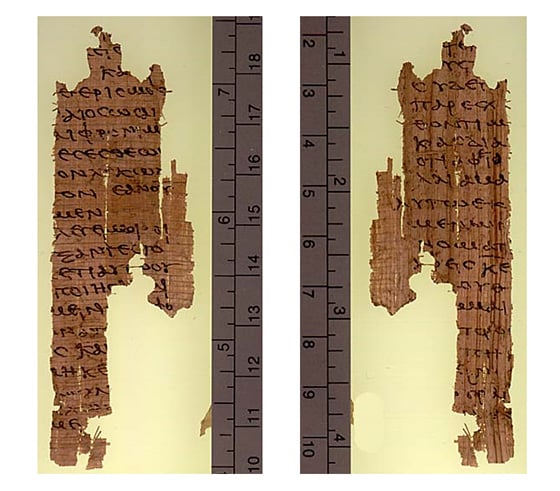
As I pointed out yesterday, the “Gospel of Peter” that we have today, discovered in 1886, is unfortunately, only a portion – the only surviving portion – of what was once a complete Gospel. But was it a complete Gospel? Or was it only a passion Gospel (like the later Gospel of Nicodemus) that gave an account only of the trial, death, and resurrection of Jesus? That has long been debated. I discussed one intriguing view of the matter some years ago on the blog, as follows: In recent years a German scholar named Dieter Luhrmann has argued that other portions of the Gospel of Peter have shown up, in very small fragments of papyrus discovered in Egypt. It is a controversial claim. The most interesting possibility, for me, is a papyrus fragment that Luhrmann published called Papyrus Oxyrhynchus 4009 (it is the 4009th papyrus published from the huge find of papyri in the trash heap of ancient Oxyrhynchus Egypt). To understand why this *might* be a fragment of the Gospel of Peter requires a […]
Tags: 2 Clement, Dieter Luhrmann, Gospel of Peter, Papyrus Oxyrhynchus 4009, POxy 4009
December 5, 2017
The Exasperatingly Fragmentary Gospel of Peter: Readers’ Mailbag December 4, 2017
My Readers’ Mailbag is stuffed, and I need to clear out a few questions to make room for others that come in. So I may be answering more than normal over the next couple of weeks. Here is one that I find intriguing: QUESTION If you could choose any currently-fragmentary or otherwise lacunose document from antiquity and magically receive a reconstructed version to read, what would it be? RESPONSE Wow. There are lots to choose from. I would probably come up with different answers on different days of the week, but the first thing that springs to mind is the Gospel of Peter, one of the most interesting of the ancient non-canonical Gospels. We have only a fragment of the book, which begins smack dab in the middle of an episode and ends, literally, in the middle of a sentence. To show why that’s so tantalizing, let me first say a bit about what the Gospel is (at least that part of it we still have!). The Gospel comes from one of the […]
Tags: Gospel of Peter
December 4, 2017
Is the Blog Meaningful for You?
Last night I hosted a dinner here on my home-turf of Durham NC. If you recall, I put out an invitation about a month ago and limited the table to six of us. I was most impressed with my dining companions. Most of them came from out of town for the occasion, as far away as Pittsburgh and Dallas. Amazing. We had a fantastic time and it was great getting to meet members of the blog and hearing their varied and intriguing life stories. I am planning on doing this sort of thing more, not just here where I live, but in various places that I will be for speaking engagements in the months that lie ahead. Everyone at dinner had things they wanted to talk about – and so did I! My main question was how we could improve the blog and do so in a way that would generate more income for the charities it supports. Over the five and a half years I have been doing the blog, I have never made […]
Tags: Food Bank of Central and Eastern North Carolina., Urban Ministries of Durham
December 8, 2017
The Pope and the Lord’s Prayer
I have received numerous queries about the Pope’s recent comments about the Lord’s Prayer. There has been a good deal of news coverage on the topic. Here is an article from my local paper: http://digital.olivesoftware.com/Olive/ODN/NewsandObserver/shared/ShowArticle.aspx?doc=NAO%2F2017%2F12%2F09&entity=Ar05202&sk=CF05DD44&mode=text The issue is summed up in that article as this: In a new television interview, Pope Francis said the common rendering of one line in the prayer – “lead us not into temptation” – was “not a good translation” from ancient texts. “Do not let us fall into temptation,” he suggested, might be better because God does not lead people into temptation; Satan does. “A father doesn’t do that,” the pope said. “He helps you get up right away. What induces into temptation is Satan.” In essence, the pope said, the prayer, from the Book of Matthew, is asking God, “When Satan leads us into temptation, You please, give me a hand.” And so I have been asked by several people what I think about that. There are at least three issues involved: What should Christians today pray? On this, […]
Tags: Lord's prayer, Pope Francis
December 10, 2017
A $1000 Challenge to Me: Did the Author of Matthew Use Luke?
As some of you know, a member of the blog, Evan, recently offered a $1000 donation to the blog if I would respond to the claims of New Testament scholar, Alan Garrow, that in studying the Synoptic Gospels, a completely compelling case can be made that the author of Matthew knew and used the Gospel of Luke. This is a view that almost no one in the academy holds. After a bit of back and forth – which I give below – Evan agreed that if I could find another respected expert in the field to respond to Garrow’s claims, instead of doing it myself, he would still donate the money. One of the scholars on the blog happens to be my colleague in New Testament studies at Duke, Mark Goodacre, who has spent the majority of his distinguished scholarly career researching, writing, and teaching on the Synoptic Problem. There is no one better to respond. And as it turns out, he volunteered to write a response without my even asking! Many thanks to Evan […]
Tags: Alan Garrow, Marc Goodacre, synoptic problem
December 11, 2017
Did Matthew Copy Luke? Mark Goodacre’s Rebuttal
Here now is Mark Goodacre’s response to Alan Garrow’s attempt to show that the author of Matthew had access to and used the Gospel of Luke in constructing his own account of Jesus’ life. This kind of argument, to carry any weight, has to get down into the weeds a bit. So brace yourself! I consider it a compelling response. Many thanks to Evan for issuing this challenge and for making such a generous donation to the blog. And many thanks as well to Mark Goodacre, who could resist dealing with an intriguing thesis that sits comfortably in his wheelhouse. I have told Evan and Alan Garrow himself that I would be happy to post a reply to Mark’s post. Alan Garrow’s most popular books are The Gospel of Matthew’s Dependence on the Didache and Revelation. Mark Goodacre is the author of several books, including The Case Against Q, and Thomas and the Gospels. ********************************************************* Garrow’s Flaw In a recent comment on this blog, “Evan” suggested that Alan Garrow’s arguments are so compelling that he […]
Tags: Alan Garrow, Evan Powell, Marc Goodacre, Q, synoptic problem
December 12, 2017
Back Again: Did Matthew Use Luke? Alan Garrow’s Reply to Mark Goodacre
As you know, I agreed to allow Mark Goodacre to respond to Alan Garrow’s unusual view of how to explain the “Synoptic Problem,” as part of the $1000 challenge by blog-participant Evan. Some of you enjoyed going down into the weeds yesterday with Mark; today I post Alan Garrow’s reply to Mark’s Response, and if you like the weeds, here are some more! If nothing else, these posts show why it is hard to make scholarship simple and accessible to the non-expert, without simplifying it out of recognition — which is the ultimate goal of this blog. If you prefer other kinds of (less weedy) fields, no worries! I’m not planning on continuing this back and forth, with one exception. Evan himself would like to post his views, and I’ve agreed to allow him to do so. But first I’ll let these two posts settle in for you, and tomorrow get back onto other things. Here now is Alan’s reply to Mark’s response. See which side you line up with! (Just one point of clarification […]
Tags: Alan Garrow, Marc Goodacre, Q, synoptic problem
December 13, 2017
Brief Reply to Garrow
I’m taking the day off from the blog (a vacation day!), but received this comment from Mark Goodacre and didn’t want it to be lost in the comment section, as I think it is important. (And for balance, I will indeed be posting, later, blog-member Evan’s assessment of the whole thing, since he started it!). Here is Mark’s response to what Alan Garrow’s post. Many thanks to Dr Garrow for his interesting response. I should point out, though, that this does not respond to my point, which is not a question about degrees of plausibility, but a question about the consistency and coherence of Garrow’s model. The issue to which I am drawing attention is straightforward: Garrow claims that high verbatim agreement in double tradition is diagnostic that Matthew is working from Luke alone. I am pointing out that on his model, high verbatim agreement does not illustrate this. I’ve added some additional comments on my blog at https://ntweblog.blogspot.com/2017/12/further-response-to-alan-garrow.html. Many thanks, by the way, to everyone for the fascinating responses to my post, and […]
Tags: Alan Garrow, Marc Goodacre, Q, synoptic problem
December 14, 2017
A Final Statement on a Different Approach to the Synoptic Problem: Evan Powell
OK, this will be the last post in this current thread involving the Synoptic Problem. Some of you will be glad to know that this one is written not at the scholarly but for normal human beings (as opposed to abnormal academics….). It should be very accessible. It is written by the blog-member who started this whole thing off with a challenge, Evan Powell. Thanks to all the participants in the back and forth – Evan, Allan Garrow, and Mark Goodacre. I don’t know about you, but I think it’s been a helpful interchange, and a (nicely) unusual thread for the blog. *********************************************** EVAN POWELL – A Solution to the Synoptic Problem The literary relationships between the Synoptic Gospels, and specifically the issue of whether Q existed as a lost sayings gospel, are vitally important questions to anyone who studies the historical Jesus and the evolution of first century Christianity. We all want to know which gospel traditions were early, perhaps originating with Jesus, and which were later ideas incorporated into the movement’s […]
Tags: Evan Powell, Q, synoptic problem
December 15, 2017
Managing the Time! Readers’ Mailbag December 17, 2017
In this weeks’ Readers’ Mailbag I will be dealing with a personal question, one that I get a good bit (twice this week!). Here is how it came to me from one blog-member QUESTION: You should once write an article on time management. Unless you sleep only 2 hours a day, I can’t imagine how you manage to publish lengthy posts, answer all comment questions every day, read lectures at the university(including all the academic responsibilities there: quizzes, exams etc.), read books/papers (both scholarly and others) and of course write them! And that’s only the academic part of your life. That’s both amazing and mysterious! RESPONSE: I have to admit, I have a lot of bad personality traits (just ask my wife!), but I have a couple of good ones too, at least ones that help me in my life. For example, I’m an unusually good sleeper! (8 hours a night, at least, and all of it solid.) And without great effort I enjoy the many simple pleasures in my life (quality time […]
Tags: time management
December 17, 2017
Blog Christmas Gift Idea #1! Free Memberships Still Available!
Do you OR SOMEONE YOU KNOW want a free one-year subscription to the blog (because, for various reasons, you, or the one you know, cannot afford it)? I STILL HAVE FREE MEMBERSHIPS TO GIVE OUT. Please ask or encourage someone you know to ask. Here is the original announcement from a couple of weeks ago, with instructions about how to obtain one. *********************************************************** Thanks to the incredible generosity of members of the blog, I am happy to announce that there are a limited number of free one-year memberships available. These have been donated for a single purpose: to allow those who cannot afford the annual membership fee to participate on the blog for a year. I will assign these memberships strictly on the honor system: if you truly cannot afford the membership fee, but very much want to have full access to the blog, then please contact me. Do NOT reply here, on the blog, as a comment. Send me a separate email, privately, at [email protected]. In your email, let me know your […]
December 18, 2017
Blog Christmas Gift Idea #2: Gift Subscriptions
Just one week before Christmas!! Are you searching for that perfect gift for someone you know and love? Or at least know? Something that would be highly meaningful on the one hand, but dead-easy to give on the other? I have the perfect suggestion: A GIFT MEMBERSHIP FOR THE BLOG!! On the landing page, at www.ehrmanblog.org, there is a bright link that allows you to give someone else a one-year membership. It looks like this: Just click it and give it! Easy as that. What fantastic gift. Something unlike anything they’ve ever received; access to posts week in and week out, throughout the year; the chance to make comments and interact with other; perfect for anyone with even a modicum of interest in the New Testament and early Christianity. A great gift for family members, friends, colleagues, acquaintances, and your favorite family doctors, dentists, plumbers, electricians, teachers, and …. and the guy down the street. So why not?!? Go for it and your Christmas anxieties will end. And the world will be a better place!
What Is the Didache & When Was the Didache Written
What is the Didache (pronounced DID-ah-kay)? In the recent exchange that I posted on the blog (dealing with the existence of Q) the document known as the Didache was mentioned. Especially by guest contributor Alan Garrow, who thinks that the Didache was a source used by the authors of Matthew and Luke. I think even Alan will agree that this is a highly anomalous view; I don’t know of any other scholar who accepts it (though if Alan knows of any who do, I’m sure he can tell us in a comment). The Didache is almost always assumed to have quoted the Gospels – or at least the traditions found in the Gospels – not vice versa. I realized this morning that I haven’t talked about it much on the blog. I better do so! What is the Didache I published a translation of the Didache (the title means “Teaching”) in my two-volume edition of the Apostolic Fathers in 2003, in the Loeb Classical Library (Harvard University Press). In that edition, I talk about what […]

- Early Christian Writings (100-400 CE)
- History of Christianity (100-300CE)
- Proto-Orthodox Writers
- Public Forum
Tags: Didache, early Christian writings, early Christianity, ethics
May 1, 2022
The Ethical Teachings of the Didache
We have been talking about the Didache on the blog, and it occurred to me that it might be useful to post part of its text, so readers can see what we’re talking about. The book has several discrete parts: it begins with a discussion of the “two ways” – one that leads to life and one to death. This is a set of ethical instructions for Christians. As you’ll see, the author appears to have taken materials from the Sermon on the Mount in Matthew and various other passages chiefly from Matthew and Luke; but he cites other ethical injunctions (some of them unusual) from other, unknown sources. After the “two ways” comes a set of instructions about church life and ritual – for example, how to baptize and what prayers to say at the eucharist meal. At the end comes a one-chapter “apocalyptic discourse” describing what will happen at the end of time. Here is the opening discussion of the two ways; it is my own translation, which, in a later version, appeared […]
- Early Christian Writings (100-400 CE)
- History of Christianity (100-300CE)
- Proto-Orthodox Writers
- Public Forum
Tags: Didache
December 21, 2017
Is the Didache One Document or Three?
I have been discussing the interesting and important early Christian document called the Didache. Yesterday I gave a translation of its first part, the “two ways” or the “two paths” section. After that the topic and tone of the book changes, as it starts to talk about how Christian baptism and eucharist should be celebrated. It ends on a completely different note, with a one-chapter description of the coming apocalypse. Scholars have asked whether the book as we now have it was actually created by someone who took several disparate texts and cut and pasted them together. Here is what I say about the matter in my edition of the Apostolic Fathers in the Loeb Classical Library (Harvard University Press, 2003). ****************************************************** The Didache obviously addresses several discrete topics: the two paths, the “church order” (which may comprise two distinct units, one on liturgical practices and the other on the treatment of itinerant “apostles and prophets”), and the apocalyptic discourse. Moreover, there is no necessary connection between them, except that provided perhaps by an editor, […]
Tags: apostolic fathers, Didache
December 23, 2017
Is the Christmas Story a Myth?
Is the whole Christian story a myth? It probably depends on what you mean by myth. For a very long time now, scholars of religion have had hard and protracted debates on what the term “myth” means, or should mean. I won’t be going into any of that here. Instead I’ll begin by talking about two teaching experiences, one negative and one positive. Negative experience: my first teaching job was at Rutgers University, where I was asked to fill in for a professor of New Testament who had to take an emergency leave of absence in the middle of the spring term in 1984. Her husband had been diagnosed with cancer, he was dying, and she could not continue teaching after giving the midterm exam. Would I be willing to take over her class for the second half of the semester? Absolutely I was willing. And I did so. It was really hard. I had to pick up wherever she left off. Among other things, she was using a textbook that I did not like […]
Christmas Reflection 2017
More than any other time, event, or celebration, Christmas, for me, shows that you can take the boy out of Christianity but you can’t take Christianity out of the boy. As much as I am a completely secular-humanist/agnostic/atheist (pick your term), I am still hopelessly attracted to Christmas and what it stands for. As I said in the previous post, it is not that I “believe” in the Christmas story (stories) as a historical event (events). In my judgment the biblical accounts have virtually nothing historical about them, other than that Jesus was born to two lower-class Jewish peasants somewhere in the land of Israel during the reign of Caesar Augustus. Beyond that – I don’t see anything historical in the accounts. No need to explain why here – I’ve talked about it enough on the blog before. And yet I’m drawn to the season and all it stands for, surely in a way that someone who had not been raised Christian simply cannot be. I think for me, in my thoroughly secular life, it […]
Tags: Christmas
December 24, 2017