Sorting by

×

Jesus’s Salvation, Self-Identity, and Birth: Key Questions from Readers

Here are three questions I've received recently on Paul's views of Christ, Jesus's view of himself, and the marital status of his mother.   QUESTION: What is your opinion on Paul’s Greek, translated as “Faith in Jesus” vs “faith of Jesus” (the faithfulness of Jesus in God’s plan?) There are a few verses this comes up in, including gospel material. (I don’t know Greek, and I’m not a linguist or scholar, and I have basically no idea what I’m talking about. However, I’m told through literature and scholarship that the Greek seems to be able to go either way.) Do you think it changes the meaning? Having faith [IN] Jesus seems to make it more about us, and less about the free gift of God. Whereas, if salvation is through the faith [OF] Jesus, it is less about us. Although, if I understand him correctly, Paul does say that we can accept or reject this gift. RESPONSE: Yes, that's pretty much the difference (a key verse is Galatians 2:16).  Is a person [...]

2026-09-25T10:20:25-04:00September 27th, 2026|Historical Jesus, Paul and His Letters, Reader’s Questions|

Do You Really Mean That? Antisemitism.

Some really important words tend to become more vague and generalized to the point where they don’t mean what they used to.  A lot of times that’s fine – doesn’t create a lot of problems.  Other times, it makes it hard for us to know what each of us is talking about.  Or it makes it easy to use a word as a tool, on the assumption that people will not know that it doesn’t mean what it used to. I showed how that is true of the terms “consciousness,” and “socialism” in the previous post.  Now I turn to a term that is far more fraught on a number of levels:  “antisemitism.” It’s a term that once had, can have, and should have, a specific meaning, and most people don’t know it.  When used with precision, the term does not refer to opposition to Jews for their religious practices and culture, to Judaism as a whole, to the modern state of Israel, or to the policies and practices of any particular Israeli government and [...]

2026-09-23T15:30:52-04:00September 26th, 2026|Reflections and Ruminations|

A Blog Dinner in Denver, CO on November 19. Interested?

Happy news!  Jen Olmos and I will both be in Denver this November for the annual meeting of the Society of Biblical Literature, and we'd love to get together with some fellow blog members while we're there. So, we're thinkin' Blog Dinner on Thursday, November 19?  Wanna come? For those who haven't attended one of these before, the idea is simple: a small group of us gets together for a good meal, good conversation, and a chance to meet one another in person. We can talk about the Bible, early Christianity, the blog, or whatever else comes to mind. No agenda, no lectures, and certainly no final exams to end it all. The only requirements are: You're a member of the blog You get there You pay for whatever you choose to consume You're willing to talk or at least listen (either or both is acceptable) (and zero is expertise required) If you'd like to join us, please send an email to at [email protected] (do not make reply with a comment here on the blog). We'll [...]

2026-09-22T14:54:07-04:00September 25th, 2026|Public Forum|

Do You Really Mean That? Consciousness and Socialism

I’m not a professional linguist, but it does seem to me that language tends to get more casual, sloppy, and imprecise over time, that words that once had a very specific meaning often become more generalized and widely applied to things that are similar but not actually the same. On one level that’s probably fine – it’s just naturally what happens when millions of people in different contexts use words and phrases billions of times.  But the downside is that without some modicum of precision we can’t communicate well and are more easily misunderstood; people often think we mean something we actually don’t. Most of the time that don’t signify, but sometimes it does. I’ll illustrate with three terms that I’ve been thinking a lot about lately, for different reasons: consciousness, socialism, and antisemitism – the first two in this post and the third in the next.    ****************************** For the past twenty years or so I’ve been interested in the problem of consciousness, how it is that we as material beings [...]

2026-09-21T11:33:08-04:00September 24th, 2026|Reflections and Ruminations|

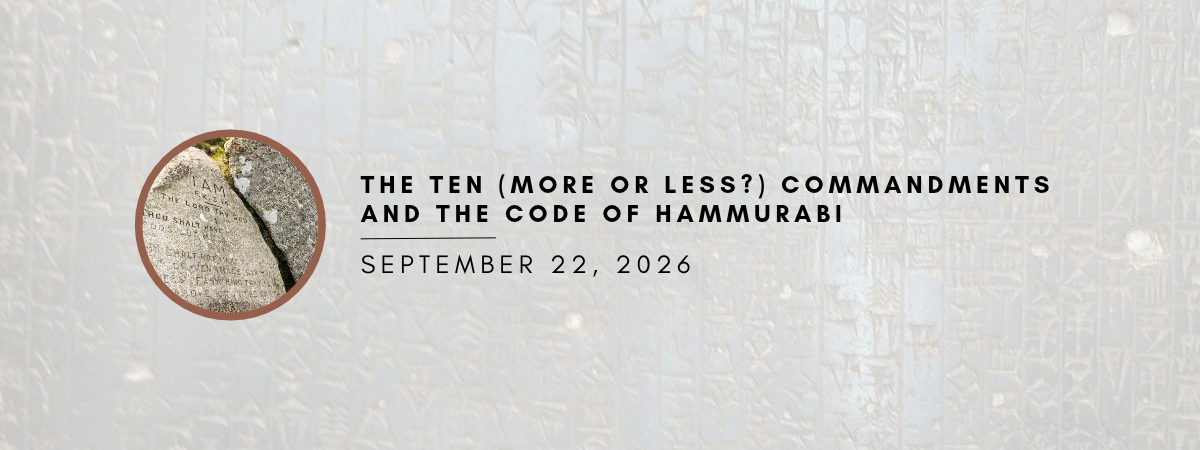
The Ten (more or less?) Commandments and the Code of Hammurabi

Here I continue my thread on interesting aspects of the Hebrew Bible not known to most people I meet at a cocktail party.  (OK, I never talk about the Hebrew Bible at a cocktail party.  But if I did, I’m pretty sure this would never come up.) Everyone knows about the “Ten Commandments.”  Even Christians who think the Law of Moses no longer is binding on them (because, they say, Christ “abolished the law”) (which isn’t true, but it’s what they say) claim that the Ten Commandments are valid (it’s usually not clear why these apply but the other laws don’t), even if they don’t know what they are (how many people can actually list them?). And they in fact willingly break one of them all the time: anyone who has done any work on a Saturday is guilty!   When my undergraduate students tell me they keep the Ten and I ask them if they have ever had a job on Saturday they usually end up admitting that they try to follow the “nine commandments” [...]

2026-09-18T11:13:39-04:00September 22nd, 2026|Hebrew Bible/Old Testament|

The Origins of God’s Personal Name and of the Feast of Passover

In the current thread (threading in and out of other posts on other things) I have been discussing some of the most interesting features of the Hebrew Bible by (re-)presenting side boxes found in my book The Bible: A Historical and Literary Introduction, 2nd ed. (Oxford University Press).  I continue the thread here with discussions of two distinct issues that have a key commonality, “where something originated.” The first part resumes an earlier post where I explained God’s actual name (“Yahweh” in Hebrew spelled with the four letters YHWH and called the “Tetragrammaton” – a name that was so holy it was not to be pronounced).  Here now I explain where the name came from.  The second part of the post discusses the origins of Passover, one of the most significant festivals of ancient Judaism, still celebrated today.  Enjoy!   BOX 5.1 GOD’S ACTUAL NAME We earlier saw that the Tetragrammaton YHWH was probably understood by ancient Israelites to be the personal name of God. But where did the name come from? It is not [...]

2026-09-16T07:35:21-04:00September 21st, 2026|Hebrew Bible/Old Testament|

Important Questions About Jesus, Paul, and the Gospels

I continue to receive significant questions from readers on key issues connected with the study of the New Testament.  Here are three of them with my responses:   QUESTION: Wouldn’t you agree that Jesus’ teaching is deeply rooted in Israel’s prophetic tradition, where judgment and restoration regularly unfold in stages rather than as a single, instantaneous event? Historically, these stages often span decades or centuries. If Jesus located his ministry within that prophetic narrative, why think there’s a contradiction between announcing an imminent judgment on Jerusalem and envisioning a kingdom whose growth and worldwide restoration would take time? The Gospels preserve both emphases. Jesus predicts the destruction of Jerusalem within “this generation,” yet he also compares the kingdom to a mustard seed, leaven, and harvest that matures over time. Rather than dismissing one set of traditions as inauthentic because they don’t fit a predetermined model, isn’t it equally plausible they reflect different stages of the same prophetic drama? Don’t you worry that the criterion of automatically assigning “delay” traditions to the post-Easter church risks becoming [...]

Health, Wealth, and the Prosperity Gospel

In the 1960s my grandmother was a big believer in faith-healer (and later prosperity-preacher) Oral Roberts.  Like many millions of others, she watched him on television and listened to him on radio, fully convinced he had the power of God to heal the sick. My father was dubious and found her faith a bit frustrating.  He asked her, “Mom, if you think he can heal you, why don’t you go get healed?”  She had very serious rheumatoid arthritis and was confined to a chair for the last seven years of her life.  I never heard her respond. But even as a boy I thought my dad had a reasonable point.  Roberts claimed even to be able to heal people long distance – just touch the TV screen or put your hand over your hearts while I pray for you.  Newspapers claimed instances of incredible success.  She could have been healed in the privacy of her own living room. As with many other Pentecostal faith healers in the early and mid-20th century, Roberts eventually shifted his [...]

2026-09-13T17:10:09-04:00September 19th, 2026|Reflections and Ruminations|

How to Justify a Lie

Yesterday I began to discuss the one Christian forger who got caught red handed who then tried to get off the hook.  Well, bend over backwards to make himself look innocent.  We've been seeing a lot of that these days.  It goes way back.  Humans are humans. Here is my assessment of the situation, highlighting my obscure little academic point: in the ancient world, readers simply did not like or approve of this kind of behavior, lying about who you as an author really were (they called these kinds of books, by the way "Pseudoi" -- Greek for "Lies").  On the contrary, they routinely condemned it.  That should be borne in mind when thinking of other instances of the phenomenon, such as those found in far more familiar books from the early Christian tradition.  (And this is the point the riles a number of my scholar friends, who just can't *believe* ancient authors would do something deceitful -- especially if their books were later included in the New Testament!). At the end of the previous [...]

2026-09-11T15:59:50-04:00September 17th, 2026|Forgery in Antiquity|

Caught Red-Handed! An Unrepentant Christian Forger

I have long argued that contrary to what you may hear a lot of people say (especially New Testament scholars!), the act of writing a book in someone else's name (e.g., claiming to be Paul, or Peter, or John, knowing full well you weren't [!]) was NOT regarded as an acceptable practice in the ancient world but was classified as a kind of lying. Scholars who think otherwise argue that the authors were not doing anything duplicitous. There are different ways scholars have made this argument, but the basic line is pretty much the same, that everyone knew that pseudepigraphy was a practice, and since they knew it was a practice, they could see through it and and either weren't deceived or weren't bothered if they found out they were deceived. I continue to think this view is absolutely and precisely wrong.  In my books on forgery I point out that whenever ancient readers *talk* about the phenomenon, actually saying anything about it, they condemn it. I'm not saying that the people who did it [...]

2026-09-11T07:54:19-04:00September 16th, 2026|Book Discussions, Forgery in Antiquity|

Pins, Gates, and Why Jesus Was Not a Capitalist

Let’s suppose Jesus was indeed a carpenter.   Where did he get his wood?  I’m assuming he didn’t pick it up at Lowe’s or Home Depot…. Pondering that question has helped me think in more granular detail about why it makes no sense to talk about Jesus in relation to modern economics.  It’s easy, of course (and completely right), to say in principle that Jesus could not be a capitalist because there was no such thing as capitalism then (or socialism, or marxism, or pick your ism).  But it’s useful to think in a bit more detail about it.  Why couldn’t Jesus be a capitalist? There certainly were people (presumably lots of them) at his time, as always, who were committed to making profits, to adjusting prices based on the market (that is, charging the most they could get), and to competing for customers without governments governing the means of production or setting prices, etc.  But a capitalist economy as we know it requires advanced technology, production, and distribution, unavailable to humans in Jesus’ [...]

2026-09-10T09:42:23-04:00September 15th, 2026|Historical Jesus|

The Perpetual Virginity of Mary (and related topics)

In my post yesterday I made an off-the-cuff reference to the Catholic doctrine that Mary was a "perpetual virgin," and indicated I'd explain more about that and related issues in a later post.  This is the post! When talking about the births of both Mary and Jesus (and related topics involving sex and conception) there are a number of terms that are often confused (especially, but not only, by those who are/have been most connected to Christianity through the Protestant tradition). Immaculate Conception. This doctrine is *not* about Jesus’ mother conceiving as a virgin; it is about Mary’s *own* mother and how she conceived Mary.  Mary, in Roman Catholic thinking, did not have a sin nature.  Otherwise she would have passed it along to Jesus.  But how could Mary not have one, if she were born and raised like every other human?  The answer came in the medieval notion of the immaculate conception: Mary herself was conceived (by her mother Anna) miraculously: God did a miracle so that even though Mary was conceived through the [...]

2026-09-08T18:19:34-04:00September 13th, 2026|Early Christian Doctrine, Reflections and Ruminations|

Jesus the Carpenter?

It seems to be virtually impossible for modern people to imagine what it was like for someone to live in radically different contexts – say, Jesus, in rural Galilee 2000 years ago.  It’s very difficult even for scholars who know a bit about his world. Lots of things never occur to us though.  At least to me.  Since I was roughly nine years old I “knew” that Jesus was a carpenter.  It never occurred to me until roughly three months ago to ask what that actually may have entailed.  And I’ve been reading scholarship on Jesus for over fifty years!  My reflections will take two posts.  This one focuses on the key passage, Mark 6:3. Mark 6 indicates that after engaging in his public ministry for a while, Jesus returns to Nazareth and teaches in the synagogue -- which does not have to mean a building; in most places like that it simply meant what the word literally signifies, “a gathering.”  Technically a synagogue was when a group of adult Jewish men came [...]

2026-09-08T18:10:08-04:00September 12th, 2026|Canonical Gospels, Historical Jesus|

October 2026 Gold Q&A Announcement

Gold and Platinum members, we've set the date and time for our next monthly Gold Q&A. It's happening on Monday October 12th at 7pm Eastern. As usual, Bart will take the first 30 minutes to answer presubmitted questions. You are invited to submit your questions ahead of time to [email protected]. For the second half of the call, you're invited to raise your hand and ask your question live. We've had some especially great questions these last few months, so come up with your best! October Q&A Info: When: Monday October 12th, 2026 at 7pm Eastern Zoom Link: https://us02web.zoom.us/j/81400681523?pwd=hO5f5EPxAD9fkLE2NmfOqsHfqB8nOR.1 Meeting ID: 814 0068 1523 Passcode: 766157 Don't worry if you're unable to make it live. I'll send the recording out the following day. Hope to see you there!

2026-09-09T16:10:33-04:00September 11th, 2026|Public Forum|

God’s Actual Name and Another Account of the Flood

Was “Yahweh” actually the personal name of the God of Israel?  And how do we explain that the world-destroying flood of Genesis 6-9 (the story of Noah) comes in so many other versions from antiquity written long before the book of Genesis appeared? I have been doing a thread on interesting features of the Hebrew Bible from my textbook, The Bible: A Historical and Literary Introduction 2nd ed. (Oxford University Press).   Here I address the two issues of God’s name and the flood, both of them accounts found in the second book of the Pentateuch, Exodus. ******************************  BOX 4.1 THE PERSONAL NAME OF GOD God is called by many names in the Bible, including Lord, God, Lord God, God Almighty, God the King, and Lord God of Hosts. But there is one term used for God that appears to have been thought of by ancient Israelites as his actual, personal name. In English, this is often given as Yahweh, based on the Hebrew word YHWH. Ancient Hebrew did not have vowels, only consonants, and so [...]

2026-09-08T13:27:15-04:00September 10th, 2026|Hebrew Bible/Old Testament|

Interesting Questions on the Teachings of the NT

I continue to get very good questions about all sorts of things we deal with on the blog.  Here are a few that have come in recently.   QUESTION: In a recent episode of your Misquoting Jesus Podcast I understood you to say that despite many errors and contradictions in the bible no doctrine is affected because it can always be found elsewhere in the text. I always believed that this was in fact not the case regarding the Trinity. If 1 John 5:7-8 does not truly belong in scripture, as I have heard claimed, I thought that there is no other place where Father, Son and Spirit are said to be One. Please can you put me right on this.   RESPONSE: Ah, I wasn't referring to errors and contradictions in the Bible, but to textual changes made by scribes.  No one change of any scribe has a decisive effect on any major Christian doctrine.  That’s because doctrines are never based simply on one verse or another, but on an entire sweep of biblical [...]

2026-09-03T17:35:12-04:00September 9th, 2026|Reader’s Questions, Reflections and Ruminations|

Modern Appearances of Jesus

I sometimes get asked why the Blessed Virgin Mary (allegedly) appears to people all the time but not Jesus.  As it turns, out, we may not hear about them as much, but there are appearances of Jesus that are recorded, some of them quite striking (here I'm not talking about in dreams but in waking life). I talk about it in my book How Jesus Became God (HarperOne)  Here's what I say there, slightly edited.. ****************************** Jesus’ Appearances in the Modern World And consider the modern appearances of Jesus. Some of these are documented by Phillip H. Wiebe, in his book Visions of Jesus: Direct Encounters from the New Testament to Today (My footnote says this: I should stress that Wiebe is not a religious fanatic on a mission. He is chair of the Philosophy Department at Trinity Western University and is a serious scholar. Still, at the end of the day, he thinks that something “transcendent” has led to some of the modern visions of Jesus he recounts. In other words, they – or some [...]

2026-09-03T09:53:11-04:00September 8th, 2026|Reflections and Ruminations|

Committed Apologists and Serious Historians

Not to be the dog across the street who won’t stop barking all night, but….  Here is another post on committed Christian apologists who insist they are doing serious history. To ward off a misunderstanding:  It is absolutely possible for a Bible-believing conservative evangelical to be a university-level, academically-gifted, peer-review-publishing, respected-in-the-field geologist.  BUT, it is not possible for her to be a university-level, academically-gifted, peer-review-publishing geologist if her views of geology are influenced by her Bible-believing conservative evangelical faith. To wit: if she tries to publish an article in an academic journal arguing that the earth really is about 6000 years old (that’s what she learned in church growing up and it’s always seemed right), and tries to cite scientific “evidence” for it, it will  not be published and she will jeopardize her career.  That’s not because of prejudice or bias, but because every serious scientist in the world knows that it is not true, it cannot be true, and that if anyone thinks it is true it is not because of the [...]

2026-09-08T18:34:14-04:00September 6th, 2026|Canonical Gospels|

Two Intrigues About Noah’s Flood

The Flood of Noah is one of the most familiar stories of the Bible. But even those who know it well often don’t think about how it actually envisions the world (or rather, universe) or know about comparable stories from other (even more ancient) Near Eastern cultures (though some will know about the Epic of Gilgamesh).  If you are among that crowd, here is the post for you!  These are two more side-boxes from my book The Bible: A Historical and Literary Introduction, 2nd ed. (Oxford University Press), slightly edited here. ******************************* BOX 3.4 THE THREE-STORIED UNIVERSE The mythical thought world of ancient writers—including the writers of the Bible—was entirely different from the one we inhabit today. Nowhere does that become more clear and obvious than in considering their “cosmology”—their understanding of the world we live in. Modern cosmologists tell us that our little planet is part of a solar system circling a rather average star in a galaxy with something like 200 billion stars; that there are some 100 billion other [...]

2026-08-28T14:27:57-04:00September 5th, 2026|Hebrew Bible/Old Testament|

Angels Seducing Women and the Rite of Circumcision: Two Peculiarities of Genesis

Was Noah’s flood meant to destroy the giants born to women seduced by angelic beings?  And what exactly was the point of circumcision? I continue here my discussion of Hebrew Bible points of interest by sharing two more of the side-boxes found in my book The Bible: A Historical and Literary Introduction, 2nd ed. (Oxford University Press).  These are both taken from my chapter on the book of Genesis. ***************************** BOX 3.1 SONS OF GOD AND THE DAUGHTERS OF MEN One of the most mysterious stories in Genesis happens right at the beginning of the Flood narrative (chapter 6) where we are told that the “sons of God” looked down among the human “daughters,” saw that they were beautiful, and came down and had sex with them, leading to the Nephilim. The word “nephilim” means “fallen ones.” According to Numbers 13:33, the Nephilim were giants. Apparently, for the story in Genesis 6, there were angelic beings (the “sons of God”) who lusted after human women, and their offspring were giants. [...]

2026-08-27T09:31:00-04:00September 3rd, 2026|Hebrew Bible/Old Testament|
Go to Top