
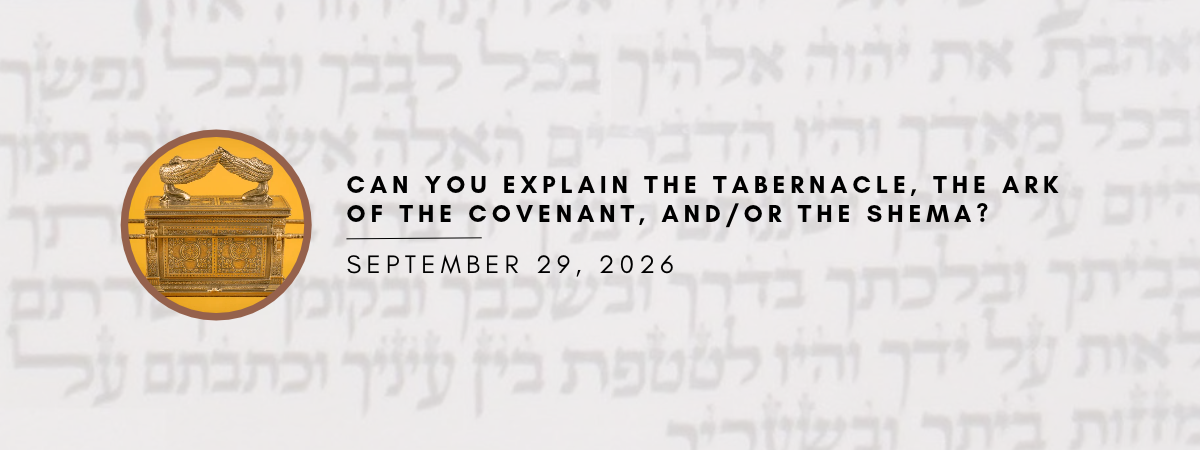
The Tabernacle, the Ark of the Covenant, and the Shema! Key features of the Israelite religion as portrayed in the Hebrew Bible, even if widely misunderstood or virtually unknown among the populace at large. (Can you explain them off the top of your head? If not, keep reading. If so, keep reading to see if you’re right. If you’re right, congratulations!)
Here I continue this Hebrew Bible thread by extracting two side-boxes from my textbook, The Bible: A Historical and Literary Introduction, 2nd ed. (Oxford University Press.
You like this post? It's free! However, you'll need to be a blog member to read most articles here. Get access to Dr. Ehrman's library of 4,000+ articles plus five new articles per week. Membership starts at $2.99/mth and every cent goes to charity!
Unlock 4,000+ Articles Like This!

BOX 6.1 THE TABERNACLE AND THE ARK OF THE COVENANT
Nearly all religions have sacred places that are set aside for the worship of the deity. But how can you have a sacred place if you are not settled down in a single location but are on the move? You can have one if the sacred place is a tent that you move with you.
According to the books of the Pentateuch, Israel was on the move after leaving Egypt and before conquering the Holy Land. According to the Priestly source P, their sanctuary was in fact a large tent called the tabernacle (see figure 5.5). It was believed in some circles that the tabernacle was a kind of mirror image of the place where God dwelt in heaven. In other words, God lived in a tent. But his tent on earth was very special (and the one in heaven, needless to say, would have been very, very special). In it was housed the ark of the covenant, on which God himself was thought to be enthroned in his manifestation here on earth.
The tabernacle was made up of woven curtains on a wooden frame. It could be assembled and disassembled as the people were on the move. It enclosed a large area of 75 x 150 feet—so roughly half the size of a football field. The inside was divided in half: the first half was where any of the Israelites could go; the other half was closed off and was only for the priests. This inner part contained a table where offerings were made, an altar, and a seven-branched lamp stand. Deeper inside was a special room called the “holy of holies”—that is, the most holy, or sacred place. This was a curtained-off room that no one could enter except the high priest, on one day of the year—the Day of Atonement—when he would make atonement for the people’s sins. Inside this holy of holies was the ark itself.
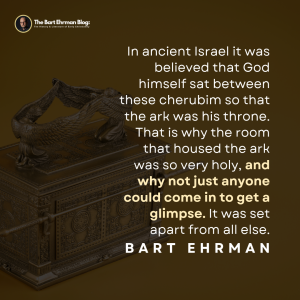
The ark was an elaborate wooden box, about 4 x 2.5 feet—the size of a modern cedar chest. It was overlaid with gold and had rings on each corner through which poles could be inserted so it could be carried. But more significant, on top of it was a covering that boasted two winged angelic-like beings called “cherubim.” In ancient Israel it was believed that God himself sat between these cherubim so that the ark was his throne. That is why the room that housed the ark was so very holy, and why not just anyone could come in to get a glimpse. It was set apart from all else.
Inside the ark were stored the two tablets that God gave Moses on Mount Sinai containing the Decalogue. This was a sacred depository, then, for the most sacred of texts: the covenant that God had made with his people Israel.
BOX 6.2 THE SHEMA
Historically, one of the most important passages of the entire Torah for Jewish worship, and eventually for Christian understandings of the Old Testament, is found in Deuteronomy 6:4-5:
Hear, O Israel: The LORD is our God, the LORD alone. You shall love the LORD your God with all your heart, and with all your soul, and with all your might.
These words are traditionally known as the Shema, because in Hebrew, that is the first word, translated “hear.” There have been various translations of the Hebrew of these verses over the years, some of them seeming to emphasize that Judaism is strictly monotheistic: “Hear O Israel, the Lord our God, the Lord is One.” But probably the first translation is to be preferred. This foundational statement of what it means to be a follower of the God of Israel is stressing not that other gods do not exist but that these other gods are not to be accepted or worshiped as gods by the Israelites. Yahweh alone “is our God.” And the sacred religious duty of the Israelite is to love Yahweh with his or her whole being.
As we will see, Jesus of Nazareth maintained that this was “the first and great commandment.” It is not the first commandment to be given in Scripture—far from it—but for Jesus, and then his followers, it is the one of first importance. Many Jewish readers to this day continue to see it as the cornerstone of their faith.
We have two goals at Ehrman Blog. One is to increase your knowledge of the New Testament and early Christianity. The other is to raise money for charity! In fact, in 2022, we raised over $360,000 for the charities below.
You must be logged in to post a comment.Over $2 Million Donated to Charity!





Share Bart’s Post on These Platforms
9 Comments
Leave A Comment
Morning from Madrid (Spain), Dr Ehrman.
I was trying to get your book, “The Bible: A Historical and Literary Introduction”, but I found that it’s now only available in ebook format.
Call me old-fashioned, but I like “real books” that you can feel, touch and smell.
The problem is that I cannot find it new for less than $500, plus delivery (add insult to injury), and that’s far too much for me.
I had the same problem with another of your books, “The New Testament: A Historical Introduction to the Early Christian Writings”, but then the 8th Edition appeared, and I was able to purchase the book new for about $80.
Is there any possibility of something like that happening with the other one? Do you know of any place where I can try to buy one at a reasonable price?
Thanks for everything.
$500?? Whoa. I have zero say over pricing of books, but all that’s ridiculous. And I agree: hard-copy is the best way to go. You can’t even find it used? ABE books, maybe? Arg. So sorry ’bout that.
Is it possible to purchase the ebook and have a copy center output it for you so you have something closer to a printed edition? It’s not a perfect solution and it might cost a bit but far less than the breathtaking $500 you mentioned.
Thanks a lot for your suggestion, ACTaormina.
I finally ordered a used one for € 87 (delivery included), and it’s due to arrive next week.
I’m a little obsessive about keeping my books in pristine condition, so let’s wait and see what they call “used, good”.
I had a similar issue when I ordered a 2nd edition exemplar of Bart’s “The New Testament: A Historical Introduction to the Early Christian Writings”, and it was highlighted and really worn out.
Luckily, as I said in my original post, the 8th edition came out, and I could buy a new one.
Let’s hope this one is not “so much used”.
http://www.abebooks.com does a good job letting people honestly know what kind of condition used books on offer are in.
Top of head no reading
• Tabernacle
is the tent that best resembles the Ramses II military tent (maybe because textiles being fragile, few examples exist). Almost as if God could be a term of address for the hegemons that claimed Syrio-Palestine? (The “Lord of Armies” epithet seems to appear in the Bible at the same time as the Ramesside Dynasty.) Usually through Amorite intermediaries, until Ramses II decided to directly control the lucrative Coastal merchant route. Then Habiru and Asrielite tribes appear commended in Ramses’ stelae, per Dr. Albright.
• Ark of the Covenant
Closely resembles Egyptian royal furniture, but closest to Akhenaten’s dad’s, I think.
• Shema
The name was initially pronounced by the public.
My best guess is that the association with Egypt became very out of style when their self-rule ended. Yah/Iah is an Egyptian deity favored by the Hyksos.
Syncretism became less popular with increasing monotheism (Like Chemosh-Ashtar, Ra-Horarkhty called the Aten, or maybe the obscure deity that replaces Seth Baal as Lord of Foreign Lands, Ha. (YaHw-H?)
Aniconism was edicted in late-stage Atenism maybe for this reason.
The name became transliterated into a local language role name: Adonai, literally meaning Gods plural.
Hi, Bart. I’m reading your Christmas blog of 2021 (https://ehrmanblog.org/which-king-of-the-jews-do-you-prefer-christmas-message-2021/).
You ask, “What kind of king do we want? One who comes in order to serve others, who is destined to provide help for those in desperate need, or one who doesn’t give a damn about anyone but himself and his own power, willing to slaughter the innocents in order to make sure he stays in power? Any modern reader of the story should realize that this is not describing an event that happened. It is describing an event that happens.”
I know you’re talking about King Herod, but yes, it’s *still* happening.
“What are you reading?”
I came across https://ehrmanblog.org/what-im-reading-these-days-you/ from 2021 and I love all the suggestions.
This is an educated, interested (and interesting) group of people and I made a note of many books to read myself.
Can you have a redo now, almost five years later?
Good idea! Thanks.