Sorting by

×

February Gold Q&A: Ask Away!

Hey Gold and Platinum members, I'd like us to get ahead of schedule for the February Gold Q&A; my plan is to record it some time this coming weekend, to be published early next week. If you have a question -- most anything related to the blog -- send it along!  To do so, do NOT reply on a comment here, but zap an email to Diane at  [email protected]. DEADLINE: Please get your question in by this Friday (01/26/2024) midnight (whenever midnight is in your time zone). Every question I get is interesting, but remember that shorter and to-the-pointer questions are more likely to be picked.  Many are called but few are chosen...
2025-09-10T13:06:11-04:00February 12th, 2024|Public Forum|

Plagiarism! Was It Condemned in the Ancient World? (Is Matthew Guilty of It?)

Just over a week ago I did an eight-lecture on-line course on the Gospel of Matthew, not connected with the blog but with BECO (Bart Ehrman Courses Online); you can find out more about that here: The Genius of Matthew.  Someone who came to the course asked me an intriguing question:  if it’s true that Matthew used Mark for a number of his stories, actually copying his account word for word in many places, wouldn’t he be guilty of plagiarism? Ah – right!  That’s certainly something we would be thinking about today!  Did people in the ancient world think about plagiarism?  There weren’t copyright laws or, in fact, any laws about the theft of intellectual property.  So was plagiarism even a THING? As it turns out, this is a topic that, I venture to say (with good reason), the vast majority of New Testament scholars don’t know about.  My (good) reason for saying so is that you can hear many such-a-scholar say oh-so-wrong things about it, either based on what they assume or what they [...]

2025-09-10T13:06:12-04:00February 11th, 2024|Forgery in Antiquity, Greco-Roman Religions and Culture|

Gospel Thrillers Part III by Andrew Jacobs

In this third and final post on his new book Gospel Thrillers, Andrew Jacobs moves into where the rubber meets my (our) road: how these novels really do seem like real life when you think about Bible scholarship and the real discoveries (or discoveries *claimed* to have been made, by bona fide scholars) of new Gospels that threaten to undo everything we think about Jesus and / or the New Testament.  Intriguing stuff.  What do you think? You can get Andrew's just now published book anywhere good books are sold, including here: Gospel Thrillers: Conspiracy, Fiction, and the Vulnerable Bible: Jacobs, Andrew S.: 9781009384612: Amazon.com: Books   ****************************** III. Gospel Thrillers come to Life   In my first blogpost I described the quirky genre of novels I call Gospel Thrillers and the way they illuminate cultural fears and desires about the Bible; I then described some of their “bombshell” secrets which, at the end most novels, turn out to be duds: readers of conspiratorial fictions more often want status quo restored than to see our [...]

2025-09-10T13:06:11-04:00February 10th, 2024|Bart's Debates, Public Forum|

Gospel Thrillers Part II by Andrew Jacobs

Gospel Thrillers!  Who woulda thought?  Many of us knew of books like this, but never realized they were a coherent (sub-)genre, and certainly never thought much about how to understand them. Here now is Andrew Jacobs second post on his new book Gospel Thrillers: Conspiracy, Fiction and the Vulnerable Bible, which you can get at your favorite book-buying spot, including here:  Gospel Thrillers: Conspiracy, Fiction, and the Vulnerable Bible: Jacobs, Andrew S.: 9781009384612: Amazon.com: Books   ****************************** II. Inside the Gospel Thrillers   In my first post I described what Gospel Thrillers are and their role in US culture: they magnify, probe, and contain popular fears and desires about the vulnerability of the Bible by imagining a conspiracy surrounding a newly discovered first-century gospel. In this second post, I describe in more detail some of the “bombshell” secrets these novels invent and the specific fantasies and anxieties about the Bible they illuminate.   Desert Fantasies Many of the books imagine new discoveries emerging from the Middle East. Some of these are supposedly part of the [...]

2025-09-10T13:06:11-04:00February 8th, 2024|Book Discussions, Public Forum|

Gospel Thrillers Part I by Andrew Jacobs

Probably all (nearly all?) of us have read thrillers, and all of us (certainly!) have heard of Gospels.  And some of us have read "Gospel Thrillers."  But do you know what a Gospel Thriller is?  You've probably never heard the term because it was recently coined by scholar of late antiquity Andrew Jacobs, in his intriguing analysis of them (the first analysis ever done), accessible to lay people (hey, we're talkin' thrillers here) just now being published: Gospel Thrillers: Conspiracy, Fiction, and the Vulnerable Bible (Cambridge University Press).  Check it out!  Gospel Thrillers: Conspiracy, Fiction, and the Vulnerable Bible: Jacobs, Andrew S.: 9781009384612: Amazon.com: Books I've known Andrew since he was a graduate student at Duke many-a-year ago.   He is now a Senior Research Fellow at the Center of World Religions at Harvard.  He is one of the leading figures in the study of Christianity of Late Antiquity (currently the President of the main professional society, North American Patristics Society). The book is terrific, and so I've asked Andrew to write a few blog posts [...]

2025-09-10T13:06:11-04:00February 7th, 2024|Book Discussions, Public Forum|

How Do Scholars Make the Apocalyptic Jesus Non-Apocalyptic?

In my previous posts I’ve given some of the evidence that is generally seen among most New Testament scholars today as a clear indication that Jesus delivered an apocalyptic message:  the end of the age was coming soon, God was to intervene in the horrible state of affairs here on earth, destroy (through a figure called the Son of Man) the powers of evil aligned against him, and bring in a good kingdom, a utopian world ruled by his own chosen one.  This was to happen very soon. This evidence that Jesus was an apocalypticist is old hat to historians of the New Testament.  But how then can some scholars contend that Jesus was not an apocalypticist?  There are several strategies that have been used, some of them marvels of ingenuity.  Two of these strategies are widely enough known among the reading public that I should say something about them.  Both involve ways of reconceptualizing our sources so that, strikingly, it is the earlier ones that are non-apocalyptic. Here's how I describe them in my [...]

2025-09-10T13:06:12-04:00February 6th, 2024|Public Forum|

A Less-Expected Argument that Jesus Preached the End of All Things

In my previous posts I've given some of the arguments for thinking Jesus delivered an apocalyptic message that the end was coming soon with a divine intervention in which all the forces of evil would be destroyed and all people judged.  I’ve actually saved what I consider to be the strongest argument for last, a final coup d’grâce.  The argument is both simple and compelling.  I wish I had thought of it myself. In a nutshell, the argument is that we know beyond any reasonable doubt what happened at the very beginning of Jesus’ public ministry and we know what happened in its aftermath.  The continuity between the two is Jesus’ public ministry itself.  This ministry began on a decidedly apocalyptic note; its aftermath continued apocalyptically.  Since Jesus is the link between the two, his message and mission, his words and deeds, must also have been apocalyptic.  That is to say, the beginning and end are the keys to the middle. Here is how I explain it in chapter 8 of my book Jesus: Apocalyptic [...]

2025-09-10T13:06:12-04:00February 4th, 2024|Historical Jesus|

How the Gospels Transformed the Apocalyptic Jesus

Contrary to the claims of the “Jesus Seminar,” Jesus is best understood as delivering an apocalyptic message – or so I began to argue in my previous post, where I explained that all the earliest Gospel sources independently record Jesus delivering apocalyptic teachings. Equally interesting, some of the most clearly apocalyptic traditions come to be “toned down” as we move further away from Jesus’ life in the 20s to Gospel materials produced near the end of the first century.  Sources closest to Jesus: apocalyptic; sources further removed in time (as the end doesn’t come) less apocalyptic.  And then non-apocalyptic.  Eventually anti-apocalyptic. I resume here with another extract from my book Jesus: Apocalyptic Prophet of the New Millennium (1999). ****************************** Let me give one example.  I’ve already pointed out that Mark was our earliest Gospel and was used as a source for the Gospel of Luke (along with Q and L).  It’s a relatively simple business, then, to see how the earlier traditions of Mark fared later in the hands of Luke.  Interestingly, some [...]

2025-09-10T13:06:12-04:00February 3rd, 2024|Canonical Gospels, Historical Jesus|

The Jesus Seminar and the Non-Apocalyptic Jesus. Hey, Why Not?

I have recently received several questions more or  less out of the blue about what I think about the “Jesus Seminar” and its views of Jesus.  I looked and it appears I’ve only had one brief posting on this issue, so I thought I should say a few things, first by explaining what the question means. The Seminar was made up of a group of about fifty New Testament scholars who, in the 1980s and 1990s, met twice a year to discuss the ancient Gospels (mainly the canonical Gospels and the Gospel of Thomas) to determine which traditions about Jesus were likely to be authentic, and which, as a corollary, were likely to have been later creations of the early church as they told stories about Jesus. The members of the seminar would then vote on each tradition – after extensive, learned discussion -- and publish the results of their votes. The voting procedure proved to be controversial. The Seminar’s original raison d’être was to establish what Jesus actually said, and so they [...]

Blog Dinner, Waynesville NC, Feb 7. Anyone Interested?

I'm going to be off to Waynesville next week  for some time away from the hustle and bustle of my normal routine (actually, now that I think about it, what *is* bustle?), to work on the next book.  And I've decided, HEY, time for a Blog Dinner!  Anyone want to come?   It's a chance to shoot the breeze with others about whatever strikes your fancy. Wednesday, February 7, 6:30 pm, place TBD (in Waynesville). The table will be limited to 8 (so we can actually all talk), so that means me and 7 others. The only requirements for attendance to the dinner would be that (a) you are a blog member; (b) you pay your own way – both getting to the event and your meal itself.  Otherwise:  no expense, no requirement, and no expectations, apart from having a scintillating evening together. If you want to come and know for sure you can, zap me a note ([email protected]). Do so right away: if past experience is any guide, the table will fill rather quickly.   I [...]

2025-09-10T13:06:12-04:00February 1st, 2024|Public Forum|

In Support of Religious Studies at a Major University

How dispensible is Religious Studies to the mission of a modern university? To the mutual chagrin of the faculty colleagues in my department, we recently learned that the chancellor of one our affiliate schools, UNC Greensboro, was considering closing down their own very fine Department of Religious Studies ( the UNC "system" has 16 public universities, over which there is a President; each university has its own Chancellor as its chief executive officer). We have signed petitions in support of the department, and several of us have written letters to explain our support. I thought it might be interesting for blog readers to see mine, since it explains why I consier Religious Studies (as a discipline) significant for university education.  There's a lot more that I could say, of course, but that would take a book, not a letter. In any event, we are hopeful that the message gets through, since all of us understand how imporant the academic study of religion is, especially in our times. ******************************   January 23, 2024   Dear Chancellor [...]

2025-09-10T13:06:12-04:00January 31st, 2024|Public Forum|

How to Sugarcoat Scripture but Seem Sophisticated. Final Guest Post by Jill Hicks-Keeton

It's amazing how committed New Testament scholars often try to tame the Bible, making it upbeat and relevant for today when, on the surface, it affirms views that most of us, when we're honest about it, simply can't abide.  And not just the Old Testament celebration of slaughter (those damn Canaanites) and execution (for, say, disobeying parents) but also the New Testament (and not just the grotesque torture and annihilations of Revelation).  Jill Hicks-Keeton, professor of Religious Studies at Oklahoma, deals with how evangelical Christians (one could pick other groups!) try to whitewash the Bible in her book Good Book: How White Evangelicals Save the Bible to Save Themselves.   This now is Jill's third and final guest post for us on the topic. Once again, she names names. Any comments?  Bring 'em on! ****************************** The ancient people who wrote the texts that would become “the Bible” lived in patriarchal societies. Modern Bible readers who see these texts as scriptural and who also deem patriarchy an undesirable way to order society have a problem to solve: [...]

We Need a Blog Volunteer! Do You Have Experience With Non-profit Taxes?

A major part of the success of the blog is the corps of faithful volunteers who do a variety of tasks, some to make the blog much better and some to make it even possible.   The only perk that volunteers get, in addition to knowing they've helped advance the spread of biblical knowledge to a wider audience and raised significant funds for charity in doing so, is a monthly webinar with me on a topic of their choice.  Those are a blast.   But for the most part, volunteers volunteer because they believe in the cause and are unusually generous human beings. We need another volunteer, someone who is qualified to file our state and federal taxes. We are, as you know, a non-profit, and our long-devoted and highly-capable books-person has recently had to bow out from the position.  We need someone with experience in this kind of thing.  Anyone with experience will not find ours a tough-case.   You interested? If so, please email us at [email protected] to let us know, and tell us a bit about [...]

2025-09-10T13:06:11-04:00January 28th, 2024|Public Forum|

How To Make the New Testament Non-Patriarchal. Good Luck with *That* One. Guest post by Jill Hicks-Keeton

I'm very pleased to post this second contribution by Jill Hicks-Keeton, professor of religious studies at the University of Oklahoma, and an author who does not appreciate "experts" who try to explain away the problems of the Bible (e.g., with respect to women) and sees no need to pull her punches!  This is an unusually effective and interesting instance; here she reveals the the flaws of a recent attempt by a  New Testament scholar to make Paul patriarchally palatable.  She names names. The post is an adaptation from her recently published Good Book: How White Evangelicals Save the Bible to Save Themselves.  ****************************** In my last post, I introduced the concept of Bible benevolence, which is the rhetorical and intellectual work that people do to make ancient texts in the Bible square with modern moral sensibilities. The Bible is not good by itself. People have to make it so. My recent book, Good Book: How White Evangelicals Save the Bible to Save Themselves, uses white evangelical Protestants in the U.S. as a case study to illustrate [...]

Making the Bible Benevolent: Guest Post by Jill Hicks-Keeton

Is the Bible "Good News" for everyone, or, does it just seem good to those who want it to be? And how do readers make it good in places that on any honest reading are not (think violence and the treatment of women and slaves).  Jill Hicks-Keeton, Associate Professor of Religious Studies at the University of Sourthern California, has recently published an intriguing book that is highly controversial in some circles (those who do what she describes) and a breath of fresh air in another, an analysis of how evangelical Christians work to make the Bible not just acceptable but good through and through.  Her study is called The Good Book: How White Evangelicals Save the Bible To Save Themselves.  (Available here:  Good Book: How White Evangelicals Save the Bible to Save Themselves: Hicks-Keeton, Jill: 9781506485850: Amazon.com: Books) I've asked Jill to talk about the book in a couple of posts on the blog.  Here's the first, with a teaser for the second! ****************************** Millions of Americans report understanding the Bible as the Word of [...]

Atonement Doctrine – A Platinum Post by Manuel Fiadeiro

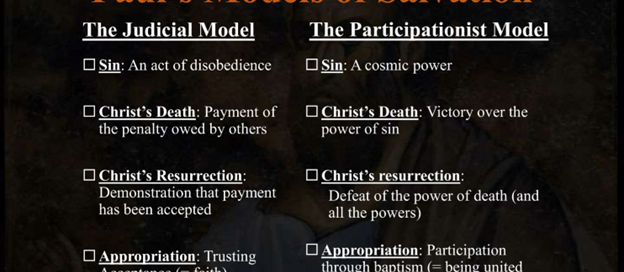
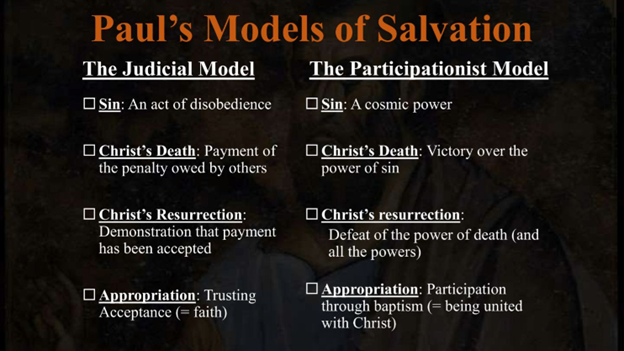
Here is an interesting reflection on the doctrine of the atonement by Platinum member Manuel Fiadeiro, for you other platinum members.  What do you think?  Do you agree with him?  Disagree?  Have an answer to his final pondering? Remember, as a Platinum member you too are allowed to make a post for other Platinums.  Do you have anything you'd like to reflect on?  Go for it! ****************************** Is it still acceptable the doctrine of atonement? The doctrine of atonement is explicitly mentioned by Paul in 1 Corinthians 15:3 “Christ died for our sins”. Bart, in his lectures on Paul, gives Paul’s two Models of salvation, or two views of the atonement doctrine: The Participation Model represents the belief of the Catholic Church. The Judicial Model represents the belief of the Protestant Churches. Those are distinct interpretations of “our sins”. The Participation Model was defined by Augustine. Adam and Eve brought Sin and Death into the world by disobeying God, eating the fruit of the “tree of the knowledge of good and evil”. So, every human [...]

2025-09-10T13:05:56-04:00January 26th, 2024|Public Forum|

Paul, the Apostate: a Platinum Post by Manuel Fiadeiro

Was Paul responsible for the split between gentile Christians and Jews?  Did he have regular visits with Jesus after he converted?  Did he consult the Alexandrian philosopher Philo about the issue? These are some of the controversial issues raised in this this guest post by Platinum Member Manuel Fiadeiro.  Check it out.  What do you think? Blog members at the platinum level are allowed to submit posts for other Platinum members only; after several come in, we take a vote and the winner gets posted to the entire blog for all to see.  Manuel's is our current winner.  If you'd like the same opportunity, check out the Platinum membership tier and its various perks, and give it a thought! For now here's Manuel on Paul: ******************************** Circa 35 CE, on the outskirts of Jerusalem, a young man, no more than 20 years old called Saul, with scribes and Pharisees, was stoning a man belonging to a sect of a Galilean called Jesus. Saul was in Jerusalem to study with the Pharisee master Gamaliel. Few students [...]

How’s the Christian World Doin’ These Days with the Ethics of Jesus?

Jesus had a distinctive ethical view, significantly different from the ethics propounded and followed by most people in his world.  And, well, by most people in ours.  Even some (many? most?) who claim to be Jesus' followers.  Or so it appears to me when I look at what Jesus actually teaches and observe what some (many?) modern Christians both do and say.    I've spent the past five posts summarizing what I plan to cover in my book The Origins of Altruism: How the Teachings of Jesus Transformed the Conscience of the West.  If history holds the publisher will be giving it a different title, and at this point for me the title's not the main thing.  Writing it is! The foci are Jesus' teachings on love, charitable giving, and forgiveness, how these teachings contrasted with those commonly followed in the Roman world at the time, how they were modified and softened by his own followers after his death, and how they nonetheless came to play an oversized role in the understanding of "how should we [...]

2025-09-10T13:05:56-04:00January 24th, 2024|Book Discussions, Reflections and Ruminations|

When Is Forgiveness not Forgiveness?

Does love really "mean never having to say I'm sorry"?  Is "unconditional forgiveness" possible?  Is it even Christian?  Is forgiveness itself always possible, conceivable, feasible, expected, required, helpful?  Actually, what is forgiveness? These are questions people often ask.  When they ask what Jesus thought about the matter they usually get it wrong.  And as it turns out, so did his own disciples.  So I'll be arguing in my book, tentatively titled The Origins of Altruism. Here's another extract from my sketch of the book as it looks at this point in the pre-writing stage.... ****************************** Part Four:  Interpersonal Forgiveness (ch. 6 on Greek and Roman World; ch. 7 on Jesus and his followers) Whereas “charity” is the manifestation of agapē principally to outsiders in need, “forgiveness” is its manifestation principally to those with whom one is in close contact. The importance of “forgoing anger” (a very broad and – as I’ll argue – somewhat problematic definition of forgiveness) was widely acknowledged in the Greek and Roman worlds.  But the conditions under which it was possible [...]

Go to Top