Sorting by

×

Did the Apostles Use Secretaries to Write their Books?

Here is the third (and last) post on the use of secretaries in the ancient world, in which I discuss the issue of whether illiterate people (like Simon Peter, or John the son of Zebedee) could have had someone else write their books for them – so that 1 Peter *could* in some sense actually be by Peter even if he couldn’t write, or the Revelation of John be by John. In it I continue to consider ways ancient authors used secretaries.  Was it actually to have them compose writings for them?  (To make best sense of this it would help to read the previous post, where I talk about two of the main ways ancient writers used secretaries.  But hey, you don't *have* to read it.  It ain't required!) Again, the discussion is taken from my book Forgery and Counterforgery (Oxford University Press). ****************************** It is Richards‘ third and fourth categories that are particularly germane to the questions of early Christian forgery. What is the evidence that secretaries were widely used, or used at all, [...]

2025-09-10T12:59:21-04:00September 4th, 2022|Forgery in Antiquity, Greco-Roman Religions and Culture|

Why Christians and Conservatives Should Accept Evolution: Blog Anniversary Guest Post by Michael Shermer (part 1)

I have been publishing guest posts in celebration of the blog's tenth anniversary, and am pleased to conclude the series now with two posts by Michael Shermer, whom many of you will know from his writings and media appearances discussing (especially) religion and science.  Michael was a one-time committed fundamentalist turned outspoken skeptic.   Here is the first of his two-parter, on an issue of particular cultural and religious importance. US public acceptance of evolution is growing but is still low compared to other countries. Why? Religion and politics. Here's why that need not be. As a career-long student of the century-long evolution-creationism debate I was encouraged to read the results of a new study on “Public Acceptance and Rejection of Evolution in the United States, 1985-2020” by Jon Miller, Eugenie Scott, Mark Ackerman, and Belén Laspra, published in the journal Public Understanding of Science. “Using data from a series of national surveys collected over the last 35 years, we find that the level of public acceptance of evolution has increased in the last decade after [...]

2025-09-10T12:58:50-04:00September 3rd, 2022|Public Forum|

Vote on your favorite Platinum Post: The Next Round!

Dear Platinum members, It's time again again for you to vote on one of our Platinum guest posts, to see which one will be posted on the blog at large.  Take a look.  It's a wide range and all very interesting.   To vote, just send a quick note to Diane at [email protected]  Your deadline:  this coming Tuesday, 9/6/2022 midnight your time. And remember — you’re always welcome to submit a post yourself.  Is there anything connected to the blog that strikes your fancy that you’d like others to read about?  Any ideas/thoughts you’d like to have disseminated and discussed?  Here’s your chance.  It doesn't have to be highly learned and informed -- just something you'd like some feed back on .  If you're interesetd, just zap me a note -- or send me a post! June 24, 2022  Onan the Barbarian: How an obscure Bible character affected reproductive rights.  Douglas Wadeson July 2, 2022 Which James in Galatians? Gregory Hartzler-Miller July 8, 2022 A Major Forgery in the Hebrew Bible? Dennis J. Folds August 22, [...]

2025-09-10T13:00:04-04:00September 1st, 2022|Public Forum|

Did Ancient Writers Use Secretaries?

In my previous post I tried to show that the disciples of Jesus were almost certainly not literate.  Yet we have books allegedly written by them.  Is it possible that people like Peter, John, James, and Jude used a secretary to write their books for them?  So that the apostles in the ultimate sense were the "author" but someone else composed the writing for them? To answer the question with something other than common sense (that is, common guessing), we need to know about secretarial practices in antiquity.  As it turns out, we do know some things, as I'll explain in this post and the next. Again, this is taken, in slightly edited form, from my book Forgery and Counterforgery, which goes into a great bit of detail about what we know about writing practices in the ancient world. ****************************** The notion that early Christian authors used secretaries .... is so widespread as to be virtually ubiquitous. There is no need here to cite references; one need only consult the commentaries, not only on the [...]

2025-09-10T12:59:21-04:00September 1st, 2022|Catholic Epistles, Forgery in Antiquity|

How Many People Were Literate in Antiquity?

Over the past month I have received a number of questions on the blog about whether it was possible that some of the apostles used "secretaries" to write their books -- so that when 1 or 2 Peter, say, claims to be written by Peter, it actually was written by Peter in a sense.  Peter told a secretary what to write and the secretary (e.g., Silvanus? 1 Peter 5:12) actually put pen to papyrus.  But the thoughts and ideas were all Peter's. It's an important question, and I've dealt with it a good bit over the years.  I actually did a short thread on it over six years ago now here on the blog.  I've decided to return to the issue.  This will take three posts.  The first is on what levels of literacy back at the time of the New Testament: how many people cold read and how many write (which is not the same thing in antiquity!); and apart from who could write, who could compose a writing? Here is what I said about [...]

2025-09-10T12:59:20-04:00August 31st, 2022|Catholic Epistles, Forgery in Antiquity|

Studying the New Testament in Graduate School

My favorite professor in graduate school once told me he thought that PhDs in New Testament were over-trained for what they had to do.  I had finished my degree at the time and was heading off to an on-campus interview at Notre Dame, which was looking for a faculty member who was an expert in Pauline studies.  They had a number of other biblical scholars there, but wanted to fill a gap in their curriculum and wanted someone with a specialization in Paul.  I didn’t consider myself a Pauline scholar in particular – at the time my research was in analyzing and classifying the Greek manuscript tradition of the New Testament, and even though I had fairly extensive training in Pauline studies, it wasn’t at all my expertise.  My professor was telling me to relax: I was more than enough qualified. Looking back, I think he had a point – not about me as a Pauline scholar (in the end they offered me the position, but I turned it down for the offer from UNC) [...]

Did the Romans Stage Jesus’ Crucifixion? Platinum Guest Post by Ryan Fleming

Here is now the third platinum guest post by Ryan Fleming.  As you might expect, it does not get any less controversial!  Do you have a reaction?  Let's hear it! ****************************** This third in a series of three posts proposes a theory that Christianity was born from Roman manipulation of the religious heart of Jewish resistance to their authority in Judea. It discusses Jesus’ trial, Pilate’s open public defense to a Jewish mob, and the spread of Christianity to Rome. Before the crucifixion, the Jewish court condemned Jesus to death for blasphemy and brought Jesus before Pilate with a fabricated Roman charge of sedition. Pontius Pilate changed the charge to “King of the Jews”. The Jewish elders asked Pilate to alter the inscription to, “This man claims to be King of the Jews.” Why did Pilate demand the charge “King of the Jews” for a Jewish peasant brought before him? Was it out of sarcasm to mock the demands of the Jewish court or was it per his own desire and design that Jesus be [...]

2025-09-10T12:59:21-04:00August 29th, 2022|Historical Jesus|

Did Jesus Believe in Armed Resistance to the Romans?

Here's a post from long ago that deals with an issue that has come up among some blog members recently.  Was Jesus in favor of armed resistance?  Were he and his disciples armed?  Was he killed for insurrection because he actually *was* an insurrectionist?   Here is the question in one of the forms I have received it, and my response.   QUESTION: What is the scholarly view on this subject: did Jesus himself, his movement and then early Christians walk around with weapons (swords, e.g.) to protect themselves, despite preaching the love for enemies? Do we have any historical evidence of how things looked in this matter?   RESPONSE:  This is a hugely important question.  I dealt with it in my book Jesus Before the Gospels, and don't think I'm able to say it any better by putting it in other words.  So here is what I said there: ****************************** In all four Gospels, at least one of Jesus’ followers is armed when he is arrested.   In the Synoptics, this unnamed follower draws his sword [...]

2025-09-10T12:59:20-04:00August 28th, 2022|Historical Jesus, Reader’s Questions|

The Canon of the New Testament: Why It Matters

With this post I conclude my thread on how we got the canon of the New Testament.  In the last post I began to talk about how having a canon affected the way people read the books of the New Testament.  Even though there are important *differences* among the various books, when they are all put between the same two covers, people read them as if they were all saying the same thing.  Here I pick up right before I left off…. ****************************** There are, for example, four Gospels, each presenting a different understanding of Jesus’ words and deeds.  The thirteen letters assigned to Paul contain inconsistencies and incoherencies (especially between the ones he actually wrote and those produced in his name later by others).  The alleged writings of James, Peter, John, and Jude also present distinctive messages, sometimes at odds with the others. But when all twenty-seven books were canonized into a single book, the statements of one writing came to be read in light of another, forcing readers (almost always unsuspectingly) to think [...]

Did Jesus Collaborate with the Romans to Produce His Movement? Platinum Guest Post by Ryan Fleming

Here now is the second of Ryan Fleming's posts arguing that the Jesus movement emerged from a collaboration with the Romans. It is for you Platinum members only.  Are you interested in coming up with a post?  It can be on any topic related to the blog.  It does not have to be scholarly.  It can be your own reflections.  You can get some good feed back from others.  Go for it! For now, here is Ryan going for it. *********************   This second in a series of three posts proposes a theory that Christianity was born from Roman manipulation of the religious heart of Jewish resistance to their authority in Judea. It discusses Jesus’ ministries, how they were conducive to Roman rule, and the role of “miracles”. Jesus offered teachings very different from Judaism. Jesus was consistently critical of the Jewish religious order; the keepers of the Mosaic Law (Luke 11:45-47 11:52), the scribes (Matt 15:1-7 23:2-3 23:13-29, Mark 12:38-40, Luke 20:46), the chief priests (Matt 21:23 21:31), the Pharisees (Matt 15:1-7 16:6 16:11-12 [...]

2025-09-10T12:59:21-04:00August 26th, 2022|Historical Jesus|

Are You Interested in Volunteering for the Blog??

WE NEED BLOG VOLUNTEERS! You may know – but probably don’t! – that we have a dozen or so people who volunteer to do various things that have to be done for our blog to work (e.g., help with finances/taxes/etc; read audio posts for Gold members; run the Bart Ehrman Blog Podcast; run the Blog Forum; do social media; and more). Now some new needs have arisen, and I need some more volunteers.  Interested?  Do you have a few hours a week (amount TBD) to pitch in to help us as we grow, develop, and (we hope) improve? Here are the three tasks we need help with:   Re-categorizing Posts As you know, the blog has been going for over ten years now; I post five times a week (counting those by guest scholars) and have done so for our entire history.  We currently have over 3000 posts, all of them available in our archives. It is relatively easy to search the archives for posts, either by looking up each category and going through the [...]

2025-09-10T12:59:21-04:00August 26th, 2022|Public Forum|

How Evangelical Apologists Are Changing Their Arguments: Anniversary Guest Post: Kurt Jaros

I continue here with my string of guest posts written by scholars in honor of the blog's tenth anniversary.  Here is a post from Kurt Jaros, an evangelical Christian theologian and apologist, in which he explains how apologetics -- the intellectual defense of the claims of the Christian faith -- has grown and changed over the years, to represent something different today from, well, when I was involved with it in my younger days. I imagine the post will elicit a response!  Kurt will be happy to address your comments. ****************************** The Growing Landscape of Christian Apologetics   When did Jesus cleanse the Temple? In the Synoptics, this event occurs toward the end of his ministry (Matthew 21:12-13, Mark 11:15-17, Luke 19: 45-46), and serves as a catalyst for his enemies to have him arrested (Matthew 21:15, 23, & 45, Mark 11:18, Luke 19:47-48). In the Gospel of John, the event occurs early on in Jesus’s ministry (John 2:14). One common approach to answering the question is to harmonize the two descriptions into a fuller, [...]

2025-09-10T12:58:51-04:00August 25th, 2022|Public Forum|

When Did We Get the Final Canon of the New Testament?

I am nearing the end of this thread on the formation of the canon of the New Testament.  Rather than going into all the ins and outs of the process, I have been laying out the topics that I hope to address in a book on the matter down the road.  I say down the road because it is not the very next book I plan to write, but the one *after* the one I now plan to write.  I like to think ahead. Here I talk about when the decisions were finalized (were they?) and what the major significance of “closing” the canon was.   A Final Consensus? Many (most?) people imagine that the canon, in the end, was decided by a vote at one of the major church councils, such as the Council of Nicaea in 325 CE (as propounded by that inestimable authority, Dan Brown, in The Da Vinci Code).  But the question of the canon was not even Blog members get five posts like this every week.  Memberships start at $2.99 [...]

How Did They Decide Which Books to Include in the New Testament Canon?

If the early Christians decided they needed writings by apostles to provide them guidance in what it meant to follow Jesus – what to believe, how to act, what rituals to follow, how to understand them, etc. – how did they decide?  Which writings were they going to include?  And which exclude? I continue here my reflections on how we got the 27 books of the New Testament, some preliminary thoughts as I consider how to write a book on the topic down the road.   How Decisions Were Made Early church communities, leaders, and individuals accepted and appealed to a range texts written by apostolic authorities.  Some Christians revered the Gospel of Thomas, which maintained that it was the secret teachings of Jesus, not his death, that could bring salvation.  Other Christians accepted the divine revelation found in one of the Apocalypses of Peter (not the one I described earlier) in which Peter narrates his own most peculiar vision of the crucifixion.  It is a puzzling scene that is difficult to imagine.  The man [...]

2025-09-10T12:59:08-04:00August 23rd, 2022|History of Christianity (100-300CE)|

Did the Romans Help Create the Jesus’ Movement? Platinum Guest Post by Ryan Fleming

Platinum member Ryan Fleming has come up with three posts that may strike you as highly controversial.   Very interesting ideas.  What do you think?  Ryan will be able to engage your questions and comments. This is the first of three posts; the others will be posted -- just for you Platinum members -- over the course of the next eight days. ******************* This series of three posts proposes a theory that Christianity was born from Roman manipulation of the religious heart of Jewish resistance to their authority in Judea. Jesus’ ministries were a collaboration with local Roman authority to change the culture of the Jewish people to be more conducive to Roman rule, collection of taxes, acceptance of gentiles, submissiveness, etc. The miracles attributed to Jesus were staged with clandestine support from Rome to enhance the popularity of the movement. The Jewish people saw through Jesus’ teachings as not being divine from their god, saw his teachings as blasphemous, and as such, rejected him and called for his execution. The Roman Prefect, Pontius Pilate, did [...]

2025-09-10T12:59:21-04:00August 22nd, 2022|Historical Jesus|

Problems in the Gospels–How do YOU Talk to Believers About Them? What Do You Think?

I recently received this query by a blog member, and it's a question I often get, both on the blog and off.  I'm hoping that maybe you yourself have some wisdom on it.  How do you talk about historical and literary problems (contradictions!) of the Gospels to people who are convinced the Bible has no problems at all? Here the question is articulated very well.  What's your experience and judgment?  Let us know what you think! ****************************** QUESTION from a blog reader: I’m fairly knowledgeable about the historical Jesus. When I find myself discussing the gospels with Christians who are not, I’m always tempted to lead with statements that certain things are not accurate: Matthew, Mark, Luke, and John didn’t actually write the gospels; the four source hypothesis; contradictions in accounts by the gospels; no post-resurrection appearances in the original version of Mark; etc. This seems like a needlessly negative approach to an informal discussion. Christians most often automatically react that I’m asserting some sort of superiority and even dogmatism over them. Do you have [...]

2025-09-10T12:59:08-04:00August 21st, 2022|Canonical Gospels, Reader’s Questions|

Writings of the Apostles in the Canon of the New Testament

How did we get the twenty-seven books of the New Testament?  And why?  I’m in the middle of a thread that is meant to provide a *sketch* of how it happened; I’ll be writing a book on the question, and these are my preliminary thoughts about the topics that I’ll be covering, one at a time. In previous posts I’ve pointed out that the early Christians started out with a canon of Scripture: as Jews they had the Hebrew Bible as an authority for understanding their beliefs, ethics, and religious practices; but as Christianity began to develop its own distinctive views on things, church leaders came to think needed authoritative direction – especially since so many different Christian groups had so many different views on so many issues (not just what to believe but also how to live, how to behave, how to worship together, and so on). What could be decisive authorities? Here’s where I pick up in my thinking:   The Need for Apostolic Authorities It was widely known that Jesus himself had [...]

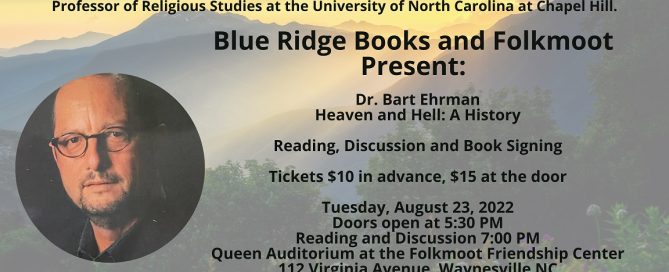
I’m Doing a Speaking Event in Waynesville Next Week!

Interested in coming to hear me give a talk/book reading?  It’s next Tuesday, August 23, in Waynesville NC.  All proceeds go to the local Indie, Blue Ridge Books, a terrific bookstore that managed to survive the crisis.  I hope you can come!  

2025-09-10T12:59:20-04:00August 19th, 2022|Public Forum|

The Birth of (the Messiah?) John the Baptist? Anniversary Guest Post by James F. McGrath

I continue now with a post that was produced for us by a fellow scholar in celebration of the ten-year anniversary of the blog.  James McGrath has made several intriguing posts for us, and this one is particularly interesting.  Is it possible that stories about Jesus -- especially in the birth narratives were *originally* told about the future messiah, John the Baptist??   That the followers of Jesus took accounts originally told of John and edited them so that they now refer to Jesus?  Very intriguing!  Here's James's post. ******************* The Birth of John the Baptist: Detecting a Source from John’s Followers Behind Three Early Christian Gospels James F. McGrath, Clarence L. Goodwin Chair in New Testament Language and Literature, Butler University, Indianapolis   Anyone who has read my previous guest posts here, or who has read academic publications by Bart and myself, will know we share a great many interests in common: the historical Jesus, the development of Christology, extracanonical texts, and many more. As I have begun to turn my attention to my next major [...]

2025-09-10T12:58:36-04:00August 18th, 2022|Canonical Gospels, Historical Jesus|

Why Did Christians Even Need a Canon of Scripture?

In my previous posts on how we got the canon of the New Testament I’ve discussed several books allegedly written by Peter – one that got into the New Testament (2 Peter); one that came close to getting in (the Apocalypse of Peter – the one that gives Peter’s first-hand description of heaven and hell; NOT the “Coptic” Gnostic one that I discussed last week in two posts); one that was thought by some proto-orthodox Christians (but maybe not many) as having a rightful place (the Gospel of Peter); and one that really never had much of a chance (Peter’s letter to James). I can now set forth an overview of what I plan to cover in my book on the canon – when I eventually write it -- and the conclusions I will draw under a series of interrelated rubrics.   These can be imagined as chapter divisions, to come after an introduction that explains the importance of the question of how we got the canon, how it has become such a pressing question for [...]

Go to Top