
Search
Advanced search
Yale Shaffer Lectures 1 of 3 – Christ Come in the Flesh
Ten years ago now — October 12-14, 2004 — I delivered the Shaffer lectures at Yale University Divinity School. The central theme of the series was “Christ in the Early Christian Tradition: Texts Disputed and Apocryphal.” Among other things, I tried to show how early Christian groups tried to restrict readings of their sacred texts to suit their own purposes. This first lecture is entitled on “Christ Come in the Flesh.” (The video quality will not be up to what we all have come to expect, as it was recorded on VHS.) Please adjust gear icon for 720p High-Definition.
Tags: Apocrypha, Christian Apocrypha, Shaffer lecture, Yale Convocation, Yale University
September 1, 2014
Yale Shaffer Lectures 2 of 3 – Christ The Divine Man
As I indicated in a post last week, on October 12-14, 2004 I gave the three Shaffer lectures at Yale University, on “Christ in the Early Christian Tradition: Texts Disputed and Apocryphal.” This is the second of those lectures, dealing with Christ as a Divine man. (Again, the quality is not as high as we have come to expect over the past couple of years, because it was recorded originally on VHS. But it’s been worked over to make it still pretty decent. Enjoy!) Please adjust gear icon for 720p High-Definition.
Tags: Apocrypha, Christ, divine man, Yale Convocation, Yale University
September 8, 2014
Yale Shaffer Lectures 3 of 3 – Christ Against the Jews
Here is the third of my Shaffer Lectures delivered almost exactly ten years ago. This final one has to do with textual variants and apocryphal texts that show evidence of Christian anti-Judaism. I call this one: Christ Against the Jews. It is a topic that I continue to be interested in, and on which I plan to write a book for a general audience, at some time in the next few years (not about textual variants, but about the rise of Christian opposition to Jews and Judaism.) Please adjust gear icon for 720p High-Definition. Quality is lacking since this is a VHS to 720p uprez:
Tags: anti-judaism, Apocrypha, textual criticism, Yale Convocation, Yale University
September 22, 2014
Upcoming Speaking Schedule and … Cruises!
I have finalized my speaking schedule for the Fall semester (I’m 58 and I still organize my life according to semesters… ) and more or less for the Spring as well. These are the events that are all open to the public; some charge for a ticket, others not. If any of these is near you, simply google the sponsor and my name, and normally that will take you to any information you may need should you want to attend. Two events in particular I want to highlight. The first is a cruise in the Caribbean this coming January 18-25. This event is sponsored by the Biblical Archaeology Society, and anyone who wants to purchase a place (and can do so) is absolutely welcome, whether you’ve ever been involved with or even have ever heard of the Biblical Archaeology Society or not. Now, you may wonder what the Caribbean has to do with Biblical archaeology. There is a clear and definite answer: Nothing At All. Well, except for the fact that the BAS is sponsoring […]
Tags: speaking schedule
September 2, 2014
My Approach to Doing Research
QUESTION: You’ve told us about reading book after book after book before you are chose to write your book. I’d appreciate your sharing a little info on how you take notes during all of this reading. And how do you decide what to make notes on what not to put into notes? RESPONSE: Right – this is a very big issue for scholars in the Humanities, since what we do, for the most part, is read books and write books. So knowing how to read books is very important. In particular it is important because there are so *many* books to read (not to mention articles – there are even more of these). How does one master the massive amount of scholarship that is out there, on any one problem? Every year, for example, there are dozens of books and articles written about, say, Jesus, or the Gospel of John, or the writings of Paul, or – pick your topic. So if one has not kept up with scholarship on, say, Jesus, for ten […]
Tags: research methods
September 3, 2014
Writing a Trade Book
QUESTION: I am interested in your writing process, and want to know how much planning you do before you put pen to paper or fingers to keyboard? Have you planned the whole book? How detailed are the plans for each chapter or do you just work with a thesis for each chapter? I am speaking of the process you go through for a trade book. I assume the process for the scholarly book is a bit different, but if so, how so? RESPONSE: I get asked this question every now and then, and think that maybe I’ll devote a few posts to trying to answer it. I will focus my response to the question specifically of how I go about writing trade books. Writing scholarly monographs is a different kettle of fish, and more people are interested, I think, in the books for general audiences, since these are the ones that get read the most. So how do I go about writing a trade book? As a preliminary I should say that I am on […]
Tags: research methods, writing
Where Do You Start Reading?
In my previous post I talked about the sequence that I go through in writing a trade book for general readers. I must admit, I’ve never systematically thought through that sequence until yesterday! I just have a way of working, and when I thought about what that was, I realized it was this sequence. 1. Doing basic research/reading/and outlining; 2. Writing a prospectus for the publisher; 3. Reading massively; 4. Outlining the book; 5. Writing it; 6. Revising it. I will describe how I go about doing each of these steps in the following posts. The first question is this: if one needs to do some basic research and reading, leading to a basic outline, as the first step – how does one decide what to read? That’s an especially acute question if you want to be working in a field that you are not overly familiar with, as was my case when I wanted this past March to start reading about “memory” – both from psychological perspectives (especially cognitive psychology) and social (“collective” memory). […]
Tags: research methods
September 4, 2014
How Do You Know What To Write About?
I continue here my thread on how I go about writing a trade book for general audiences. So far I have talked about how I start with reading about the topics of relevance. When I’ve done a lot of that I eventually get to the point where I realize I’ve read all the major works that I need to have read in order to have a good sense both of what others have said about a topic and about what I have to say myself. Maybe I should pause a bit – for a post or two — on this question of “what I have to say.” There are several aspects of this question that are important and fairly interesting. The first has to do with having an idea about what to write. I’ll get to the issue in a roundabout way, which is my wont, as you may have noticed… I’ve had graduate students now for twenty-six years, and over the years they have evidenced a wide range of both ability and temperament. Of […]
Tags: dissertations, writing
September 6, 2014
Choosing a Topic for A Trade Book
In this thread I’ve been talking about how I go about writing a trade book, and I am now dealing with the question of how an author chooses what to write about. I was indicating earlier that some of my graduate students have a difficult time knowing what to focus on in their dissertations. Most of my students come up with amazingly good ideas; but every now and then I have a student who simply can’t decide what to do. It’s hard because the dissertation is their first book, it has to be academically rigorous, on a topic of some intellectual importance, and dealing with it in a way that has never been done before. The same is true with all works of serious scholarship. Having said that, I should point out that the New Testament itself is the most heavily researched book (or set of books) in the history of civilization. And lots of areas of New Testament scholarship are thoroughly “over-researched.” That makes it hard for students and even senior scholars sometimes to […]
Tags: trade books
September 8, 2014
Communicating with Non-Scholars
In my previous post I talked about how I go about choosing what to write a trade book on. In some cases I have chosen to write on a topic that involves a well-worked field in biblical studies or early Christianity, that has not, however, been introduced to a wider reading public. I’ve always found it highly unfortunate that scholars as a rule are not interested in communicating with non-scholars. I should be clear about one thing, though: some scholars – or rather, most scholars – simply don’t *know* how to communicate with non-scholars about whatever it is they’re doing. And to a large extent, it’s not actually their fault. Many (most?) scholars don’t know how to communicate with others is that they were never trained to do that. In fact – this will come as a surprise to many people – back when I was in graduate school, in the 1980s, people being trained to become university teachers almost *NEVER* had any instruction on how to teach. My program was typical of most. My […]
September 9, 2014
How I Begin to Write
OK, I’m back from my tangent. This thread is about how I go about writing a trade book. So far I’ve discussed how I decide what to write on, how I imagine communicating with a popular audience about it, how I know where to begin reading, how I go about acquiring bibliography once I start, and how I try to read everything of relevance and take notes on it all. Now I can get to the writing process itself. For years I used to tell my graduate students what, in my opinion, was the best way to go about writing a book (when they were starting to work on their dissertations). To my knowledge, none of them ever took my advice. So I quit giving it. Not so much because I was disappointed but because I realized that everyone works differently. Then I met my now-wife Sarah and realized that some people work *completely* differently. Sarah could never do what I do (I’ll explain what that is in a moment). Her mind doesn’t work like […]
Tags: writing process
September 10, 2014
How I Actually Write
I can now explain how I actually go about writing a trade book (how I do it with a scholarly book is a bit different, mainly because it is a much slower and laborious process). As I’ve indicated, before I start writing at *all*, I have already read everything that I have needed to read (nothing still left! Otherwise it’s a disaster), taken notes on everything, reviewed my notes assiduously, and made detailed and lengthy outlines of each chapter. Then I’m ready to go. The writing of the book itself is the only anxiety-producing, tense, emotionally difficult point of the entire process. I feel no nervousness or anxiety or dread in any of the other stages of the work – only in the writing. Moreover, this is far and away the most intense point of the process, where I completely go into a zone and live in an alternative universe. Different people have different views of how to write. Some scholars prefer to write slowly, carefully crafting every sentence, being sure that one sentence is […]
Tags: writing process
September 11, 2014
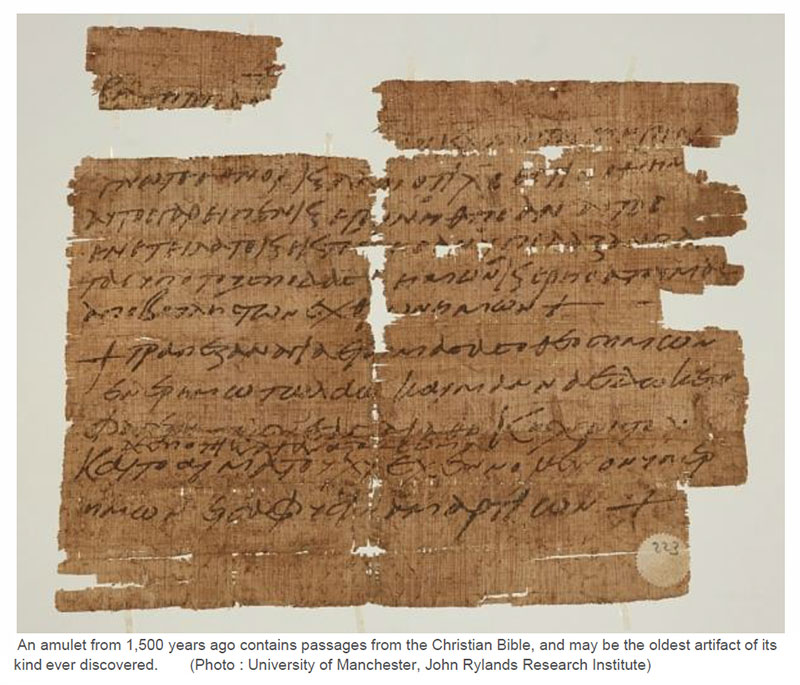
New Discovery of an Ancient Christian Amulet
A new discovery has been made of an ancient amulet, of interest to students of the Bible. It contains some references to both the Hebrew Bible and the New Testament. An amulet was a kind of lucky charm that a person carried or wore, in order, principally, to ward of evil spirits. I will say more about amulets as they relate to the use of sacred books (esp. the Christian New Testament) in my next post. For now: here’s news of the new discovery in an article by James Maynard, taken from the Tech Times. ********************************************************************************************** Discovery of Ancient Papyrus Amulet with Biblical References Excites Boffins By James Maynard, Tech Times | September 8, 7:13 a.m. An ancient papyrus amulet with hand-written biblical passages has been discovered. The artifact was likely a tax receipt, and 1,500 years ago, someone wrote quotes from the Christian Bible on the back. The Greek papyrus artifact contains text referring to the Last Supper of Jesus Christ, as well as “manna from heaven.” The ancient amulet containing the papyrus artifact […]
Tags: Papyrus Amulet
September 12, 2014
Manuscripts and Christian Magic
My last post on the discovery of an amulet with passages from the Bible on it brought to mind part of an essay I wrote and recently edited for the second edition of the book that I edited (with Michael Holmes), The Text of the New Testament in Contemporary Research: Essays on the Status Quaestionis. The book contains essays on every major aspect of NT textual criticism by different authors, all of them internationally known experts in the field, with articles on papyri manuscripts, majuscule manuscripts, minuscule manuscripts, lectionaries, Greek Patristic citations, Latin Patristic citations, early versions such as Syriac, Coptic, Latin, methods for studying the manuscripts, and … lots of other things. My essay is called “The Text as Window.” It is about how the manuscript tradition of the NT can tell us about the social history of early Christianity – including the use of magic. Here is the short section devoted to that question of magic (endnotes are at the bottom): *********************************************************** The incursion of the social sciences into the study of early […]
Tags: magic, manuscripts
September 14, 2014
A Day In the Life of a Research Professor
I sometimes get asked what it is that professors in universities actually do. The question is usually raised when someone realizes that at a major research university, most professors teach two classes a semester. Classes tend to involve three hours of class time per week. But that means a professor is in the classroom only six hours a week. Is this a full time job? Are you serious?? And on top of that you have tenure so that you can, for all practical purposes, never get fired? Hey how can *I* get a job like that??? It’s a really good question. First let me say something about what it is professors do, maybe in a couple of posts, and then say something about tenure. As it turns out, being a full-time professor is a boatload of work. I won’t say that it’s more than a lot of other busy and highly demanding occupations – a lot of you, I’m sure, work just as hard and long as I do. But it *is* a busy and […]
Tags: research professor
September 16, 2014
The Academic Tenure Situation
In my previous post I discussed what a professor at a research university does with his or her time. I did not go into detail about a lot of the really time consuming obligations, which I may at some point devote a post to. For now I want to deal with one other thing that I mentioned in yesterday’s post: the question of tenure. Most people in the rest of the working world have trouble getting their mind around what university tenure is all about. You mean they guarantee you a job for life? They can’t fire you? Really??? Yes, pretty much really. With some provisos. The tenure system has come under fire in recent years by those outside the system who think that it is a disaster and a bit of a joke. It is sometimes thought or said that that once a professor has tenure, there is no incentive for him or her to do much of anything: they have a job — permantently! And that, it is said, is a recipe for […]
Tags: tenure
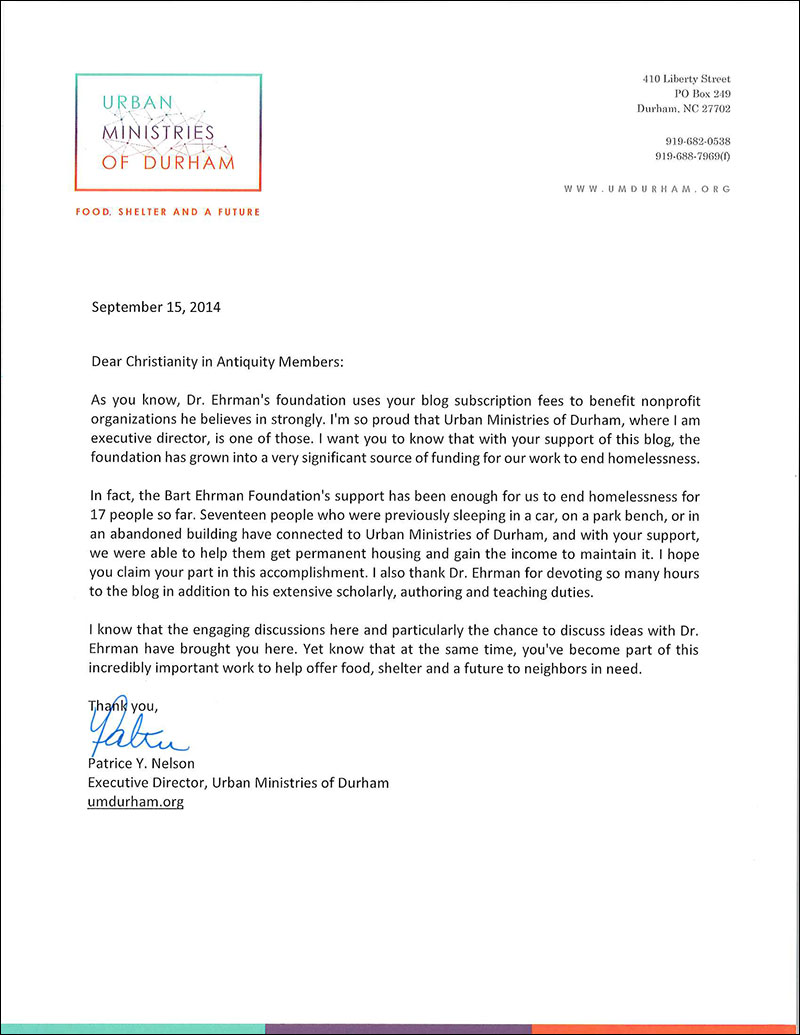
Letter from Urban Ministries of Durham
As most of you know, there are four charities that the Bart Ehrman Blog supports. Two of them are international: CARE and Doctors Without Borders. Two of them are local to me: The Food Bank of North Carolina and the Urban Ministries of Durham. I very much wish we could support all of them more and more — they are all superb organizations. But I have a special soft spot for the Urban Ministries of Durham. Despite its name, it is not a religious organization. It is the principal organization that deals with hunger and homelessness in my community. It’s a huge task. But what is really amazing about UMD is that they are not interested in simply putting a band-aid on the problem, for example by having a soup kitchen and an emergency shelter. They do have those, and a clothes pantry and a food pantry and much more. BUT what is really impressive is that they work very hard at *eliminating* homelessness (and hunger), by getting homeless people into jobs and into […]
Tags: Urban Ministries of Durham
September 19, 2014
What Counts for Tenure?
I have one more post to make on this thread, which has taken me off onto a tangent, away from early Christianity per se and onto what it means to be a university professor at a research institution such as UNC. That other post – hopefully tomorrow – will be about why tenure is absolutely essential for this kind of job, even if it is highly unusual anywhere else (unheard of, of course, in the business world). But before then, I want to say one other thing about the tenure process, something that would not occur to most people and that in fact will be both surprising and, possibly, counter-intuitive. It has to do with what “counts” as research. Virtually every school on the planet will tell its assistant professors that there are three factors considered in evaluating a case for tenure: research, teaching, and service. The balance of those three factors, though, differs significantly from one school to another. Some schools focus almost exclusively on teaching, so that research is not that big of […]
Tags: tenure
September 17, 2014
Why We Need Tenure
I’ve been discussing what a university professor does with his or her time, and have devoted a couple of posts to the question of what it takes to receive tenure. In doing so I have indicated that tenure is a guarantee of life-long employment by the academic institution, barring such extraordinary circumstances as moral turpitude on the part of the professor (it happens!) and financial exigency of the institution (it too, alas, happens). I should say as well, though, that once one receives tenure it is no pure boondoggle for the rest of one’s life. At UNC, at least, we have a mandatory “Post-tenure Review” process every five years, where we who have tenure have to explain in writing what we have been doing in our teaching, research, and service since the previous review. If performance is not satisfactory, a plan of remedial action is implemented, and if things go from bad to worse, disciplinary actions can be implemented. But for most of us, we’re working our tails off all the time anyway, so there’s […]
Tags: tenure
September 18, 2014
My New Testament Textbook
I thought I would take a few posts to talk about what I’m working on these days – for the past month or so, with another month or so to go. As many of you know, I spent almost the entire summer doing nothing but reading books and articles about “memory” and related topics (such as the telling of stories in oral cultures) from a variety of perspectives: cognitive psychology, neurology (very low level!), anthropology (oral cultures and how they pass along their traditions), sociology (communal memory), folklore (urban legends, rumors, gossip), and so on. All of this was in preparation for my next trade book dealing with what we can say about the oral traditions of Jesus as they were passed along in the years before the Gospels were written. I am still leaving open the possibility of writing a scholarly monograph on a similar topic. But I have had to take a break from all that. And with huge reluctance. There are dozens and dozens of books and articles that I’m still desperate […]
Tags: New Testament, textbook
September 22, 2014