Sorting by

×

Casting Doubt on Jesus as the Carpenter…

As a late teenager deeply committed to Christianity and invested in debate – making arguments, evaluating evidence, convincing skeptical judges – I was naturally drawn to Christian “apologetics,” the attempt to demonstrate the truth claims of Christianity based not on faith but on proof.  And so, like others in that boat at the time, and like many still today (often still using the same arguments we did), I had at my ready disposal numerous “proofs” for the existence of God, the fulfillment of prophecy, the divine nature of Christ, his (actual, physical, historical) resurrection from the dead, and the full inspiration of Scripture. One of my favorite go-to guides for persuasive logic was a book by Josh McDowell, Evidence that Demands a Verdict.  Later I became equally interested in his Christologically-focused (but still apologetic), More than a Carpenter. These days I am obviously no longer arguing for the truth claims of Christianity, and even more – as I head further down the slippery slope that leads to perdition (as we used to say) [...]


2026-10-21T20:44:21-04:00October 25th, 2026|Historical Jesus, Public Forum|

What’s Wrong with Being a Carpenter??

In my previous post I tried to show why the evidence that Jesus was a carpenter before beginning his public ministry is thin at best.  It is found only in Mark 6:3 (“isn’t this the carpenter?”), which is changed in Matthew (to “son of the carpenter”) and Luke (to “son of Joseph”).  John doesn’t have the passage and doesn’t say anything about Jesus being a carpenter, nor do any of the other books of the New Testament, nor any other early Christian writing at all, apart from those that are getting it from Mark. This raises three questions that may seem different (since they are) but are actually related: (1)  Why did Matthew and Luke, and then later scribes of Mark, change it?  (2) Is it true historically?  (3) If not, can we think of a reason Mark may have invented it?  I’ll take them in order.  This will take three posts.   Why Did Matthew, Luke, and Later Scribes Change It? With the change, Jesus is no longer said to be a carpenter.  Later [...]

Next Platinum Lecture on November 14th

Platinum members, as you know, one of the benefits of your subscription is a quarterly lecture by Bart followed by a Q&A. These lectures provide an opportunity to dig deeper into a particular topic and offer an opportunity to ask your questions to Bart directly. mark your calendars for our next Platinum lecture, which is scheduled to take place on Saturday November 14th at 2pm Eastern. The topic for this quarter's lecture is still being finalized, but check back to this post for an update as we get closer to the event date. I will also include it in the weekly Friday roundup email I send out. Can't make it live? I'll send the recording out to all Platinum members shortly after the event. Here's the info you need to join live us on November 14th. When: Saturday November 14th at 2pm Eastern Zoom Link: https://us02web.zoom.us/j/87488828498?pwd=qpZuae7Da52zGVR6BuVU2o17AnU9NZ.1 Meeting ID: 874 8882 8498 Passcode: 063466   We hope to see you there!

2026-10-22T23:45:25-04:00October 23rd, 2026|Public Forum|

Was Jesus a Carpenter? The Surprisingly Thin Evidence.

Was Jesus a carpenter?  Nearly everyone assumes he was – not just the two billion Christians but also the other billions who have ever thought or heard about it.  And they have done so for 2000 years.  As it turns out, the evidence for it is very thin. I just came to think seriously about this recently.  I’ve been doing a lot of reading and reflecting on what it would be like to grow up and live in a place like Nazareth, a small rural village of maybe fifty small houses that together accommodated maybe 400-500 people altogether.  Archaeologists have uncovered no indications of any wealth there (e.g., nice kitchen ware, mosaics, large residences, etc); no public buildings (synagogue, school, town hall, or whatever), and have concluded that it was – like so many other rural villages – an agricultural community. Everyone would have had their own plots of land large enough to grow what they needed and nearly everyone would have “made a living” by working their plots.  Some people may have [...]

Supernatural “History.” Church Fathers. Atonement. Gospel Sources. All Sorts of Questions!

I continue to receive great questions from folk and continue to try to answer them.  Here is a wide range on key issues for anyone interested in the informed study of the New Testament. ******************************  QUESTION: Do critical scholars agree that miracles and the supernatural are outside the purview of the historical process?  If so, can you present the evidence to that effect? Is this what is taught in post grad history schools outside evangelical institutions?   RESPONSE It doesn't take much evidence.  Read any historical account of, say, WWII, the Civil War, the French Revolution; the presidency of George Washington, JFK, Obama; the voyages of Christopher Columbus, the Industrial Revolution, the rise of Capitalism; the ... pick any historical topic.  In every case there were people who said prayers of relevance for the persons, events, etc; some of these people at the end of the person’s life or at the end of the episode concluded that God must have been on their side (since what they hoped had happened did happen). You [...]

2026-10-21T19:48:52-04:00October 21st, 2026|Reader’s Questions|

An Even Stranger View of Eternity in the Book of Revelation

In my previous post I pointed out that there seems to be an irony in the teachings of Jesus about the coming Kingdom of God.  On one hand, it seems like it should be a completely utopian place where there are no longer any enemies of God or animosity and strife among humans, a return to the glory days (maybe literally only days) of the Garden of Eden.  On the other hand, Jesus will be the “king” and his twelve disciples will be “co-rulers” in this kingdom.  But why will they need a king and rulers?  There is only now peace, harmony, love, and an eternal ecstatic existence without sin, suffering, pain, or misery caused by illegal or illicit activity, right?  So what are the rulers going to be doing exactly? This same irony is found in even more pronounced terms in the final book of the New Testament, the book of Revelation.  In my book Armageddon I argue at some length that the values and priorities of Jesus are almost completely missing from this [...]

2026-10-13T11:27:22-04:00October 20th, 2026|Revelation of John|

The Irony of Jesus as the King of the Coming Kingdom

Jesus believed there would be levels of reward in the coming Kingdom of God, as I began to show in my previous post.  Could there be any problems, though?  Any unruliness? Any need for discipline and judgment for people who did something illicit or harmful?  Could or would people sin in the Kingdom of God? These are tricky questions that Jesus never addresses directly in the canonical Gospels.  I never even thought about them or realized they could  be problems until, well, something like two weeks ago.  My assumption since I became a sentient human being has always been that the afterlife for the saved would be perfect in every way, that there would be no pain, misery, suffering of any kind, no harm done to anyone, no sin or disobedience.  A realm of perfection. This indeed is what most people think about heaven today.  But as I’ve repeatedly emphasized, Jesus had a different understanding than his modern day followers about the “Kingdom of God.” For him it was not to entail a [...]

2026-10-07T22:20:21-04:00October 18th, 2026|Historical Jesus|

A Head-Scratcher in the Sermon on the Mount: Who Gets Into the Kingdom?

There is a passage in the Sermon on the Mount that is crucial for understanding Matthew’s portrayal of Jesus, as I’ve taught for years, without, though, being able to get my mind around it completely.  It doesn’t seem consistent with itself.  Here’s Matthew 5:17-20 in the New Revised Standard Version (Updated Edition): 17 “Do not think that I have come to abolish the Law or the Prophets; I have come not to abolish but to fulfill. 18 For truly I tell you, until heaven and earth pass away, not one letter, not one stroke of a letter, will pass from the law until all is accomplished. 19 Therefore, whoever breaks one of the least of these commandments and teaches others to do the same will be called least in the kingdom of heaven, but whoever does them and teaches them will be called great in the kingdom of heaven. 20 For I tell you, unless your righteousness exceeds that of the scribes and Pharisees, you will never enter the kingdom of heaven. The problem I’ve had with understanding the [...]

2026-10-06T16:45:34-04:00October 17th, 2026|Public Forum|

November 2026 Gold Q&A

Gold and Platinum Members, our November Q&A is coming up. Join Bart live on Saturday November 7th at 3pm Eastern as he answers your questions. Bart will spend the first half of our Zoom session answering your pre-submitted questions. Send yours to [email protected] no later than Thursday November 5th so we can add it to the queue. Then we’ll open things up. During the second half, you’re invited to come on the microphone and ask Bart a question live. If you’d like to participate in the live Q&A: Prepare your question in advance Keep your question to roughly 20 seconds or less Be ready to ask it live during the session Meeting Details: Zoom Link: https://us02web.zoom.us/j/82830700496?pwd=X00BfdDVOTY6Vh36zDPQacEDXDArji.1 Meeting ID: 828 3070 0496 Passcode:875235 And if you’re unable to make it live, I always send the recording of the event to all Gold and Platinum members shortly after the event. We hope to see you there. – Jen

2026-10-16T00:10:55-04:00October 16th, 2026|Public Forum|

How Much Reward Do You Want? The Tiers of Heaven

I have become deeply interested in the question of whether Jesus thought that people should be considered equally and treated as equals, and that has led to my ponderings on Jesus’ view of the afterlife for those who are “saved.”  Will everyone in the future kingdom of God be treated equally?  That made me reflect on the fact that there is a longstanding view within the Christian tradition that says: definitely not. This view of differentiated afterlives is portrayed most emphatically in one of the most popular and influential portrayals of the realms of the blessed and the damned referenced in my previous post, the Apocalypse of Paul.  This is a fictional narrative of a personal tour granted to the apostle, which attempts to explain Paul’s claim in 2 Corinthians 12:1-4 that he was taken up to “the third heaven” and shown things that he is not to reveal.  The fourth or fifth century author of the Apocalypse of Paul, claiming himself to be Paul, decided to reveal what “he” (allegedly Paul) actually saw.  That [...]

2026-10-06T11:51:25-04:00October 15th, 2026|Christian Apocrypha|

Are People Treated Equally in the Age to Come?

For nearly all my life – until a few months ago, actually – I assumed that Jesus favored and promoted equality: everyone deserves equal treatment and will receive equal rewards from God if they are on his side and survive the coming day of judgment.  This really was a pure assumption on my part.  I never much thought about it and didn’t realize I was simply assuming it.  Hey, I believe everyone deserves to be treated equally.  And if that’s what makes sense to me, obviously all right-minded people would think that.  And who was more right-minded than Jesus? But now that I have put some thought into it, I’m not sure Jesus would agree. Certainly, I’d say, Jesus thought everyone was free to accept and follow his teachings and could equally receive God’s gracious gift of salvation.  For Jesus, “salvation” meant surviving the coming onslaught that was to appear soon on the Day of Judgment, when God intervened in history by sending a cosmic judge who destroy all of God’s enemies – [...]

2026-10-16T00:16:39-04:00October 14th, 2026|Christian Apocrypha, Early Christian Doctrine|

Great News For the Blog! A Significant Milestone

I’ve got some exciting news about how we’re doing on the blog this year – with respect to funds raised, and in connection with a series of posts I did last year.  The funds, as you’ll see below, are significant.  To this point, in terms of the  monies we’ve given to our charities, this is our best year yet of the fourteen we’ve had running this show. First let me explain a long-term project that ended up making a big difference. As (lots of you) know/remember, I did that “New Testament in a Nutshell” series in 2025, producing usually 3 or 4 posts on each book of the NT in canonical sequence, from Matthew to Revelation.  You can still see them all, easily enough.  Just do a word search for “nutshell” and you’ll see them. The first post gave a 50-word (exactly!) summary of the book, and then a longer exposition of its major themes and emphases.  A second post discussed Who wrote it, When, and Why.  A third post discussed one of the more [...]

2026-10-07T22:33:38-04:00October 13th, 2026|Public Forum|

Did Jesus Believe in Equality? You Might Think So….

Did Jesus believe in equality, and if so, what would that mean?   It obviously means different things to different people in different contexts (we don’t equally mean the same thing…). Our (the U.S.) declaration of national independence insisted that “all men are created equal,” but it really did mean “men” (not women) and none of the Founders thought that their incomes and possessions should be equal to those of hoi polloi they saw in the streets. So too, the apostle Paul said that “There is neither New nor Greek, neither slave nor free, nor male and female; you are all one in Christ Jesus” (Galatians 3:28).  But he also told women that the head of a “man” was Christ, the head of a “woman” was her husband, and women were therefore to show due deference by wearing a head covering in public (1 Corinthians 11:3-10). What about Jesus?  Did he believe everyone was “equal,” or more important, that they should be?  Was it part of his ethical teaching that we should strive for social, political, [...]

2026-09-30T17:25:10-04:00October 11th, 2026|Canonical Gospels, Historical Jesus|

A Very Different (not to say Bizarre) Gospel Featuring Mary Magdalene

To round out this brief thread of Gospels connected with Mary Magdalene, I've decided to repost something from a few years ago that almost no one outside of the small pond of early Christian studies knows about, a book called  “The Greater Questions of Mary” (i.e., of Mary Magdalene). Trigger warning: sexual content! (Really???) One of the “great questions” for scholars is whether such a book ever really did exist. It is mentioned only once in ancient literature, in a highly charged polemical context by Epiphanius of Salamis, a Christian heresy-hunter who was prone to exaggeration and fabrication, who was incautious at best in his attacks against heretical sects in his book the Panarion (= “Medicine Chest”; in it Epiphanius supplies the “antidotes” for the “snake-bites of heresy”). The most notorious of the groups that Epiphanius attacks were known by a variety of names, including the “Phibionites.” According to Epiphanius -- our sole source of knowledge about the group -- these gnostic believers engaged in nocturnal sex rituals that involved indiscriminate sex, [...]

2026-09-30T10:24:02-04:00October 10th, 2026|Christian Apocrypha|

Where Christianity Started, And Why – Platinum Guest Post by Peter van Kan

I am pleased to publish this Platinum post by Peter van Kan, in which he explores why Jesus would come to think he was the messiah, and makes the case that he is best understood as a Jewish mystic, largely misunderstood by the writers of the Gospels.  Interesting thesis!   What do you think?  Feel free to comment and give your opinion. ******************************   In this article I aim to narrow down where in history the junction ‘christianity or no christianity’ lay. Having found the place, the obvious next question is: why did history take the christianity direction?   Not Before going into the issues, let me clarify that I take a lot for granted here. ‘Granted’ meaning: concluded by biblical scholars, genealogist, archeologists, etymologists and other gists. There was no Abraham and there was no Moses. And if there had been people by such names, they did not remotely resemble their namesakes pictured in the OT. God did not have a special bond with Hebrews or Jews. Or any other people for that matter. [...]

2026-10-08T09:08:23-04:00October 9th, 2026|Public Forum|

Was Mary Magdalene the Actual Founder of Christianity?

In my last post I talked a bit about the relationship of / competition between Peter and Mary in early Christian traditions.  Peter, of course, has traditionally been seen as the “rock” on which Christ built his church, the very foundation of Christianity (Matt. 16:18 – “You are Peter (Greek: petros) and upon this rock (Greek: petra) I will build my church.”).   And indeed, according to 1 Cor. 15: 3-5, Peter was the first to see the resurrected Jesus (and realize he had been raised from the dead), and that is the very beginning of Christianity. But what if the Gospels are right, that Mary actually was the first.  Wouldn’t it make better sense, then, to say that Mary started Christianity? Here is how I talk about the matter in my book Peter, Paul, and Mary Magdalene: ****************************** There is no doubt that Peter became dominant as the leader of the church early in the Christian movement, and Mary receded into the background.  We have scores of passages that talk about Peter, his involvement with [...]

2026-09-30T10:32:52-04:00October 8th, 2026|Canonical Gospels, Women in Early Christianity|

Peter and Mary Magdalene Going Toe to Toe

In my previous post I talked about the Gospel of Mary Magdalene and ended with the passage showing her having a rather serious disagreement (after Jesus' death) with Peter about whether she could have been favored by Jesus.  I want to pick up there, and show how not just in the Gospel of Mary but in other parts of the early Christian tradition Mary and Peter were sometimes portrayed in controversy over who was Number One! Here is how I discuss it in my book Peter, Paul, and Mary Magdalene. slightly edited here. ****************************** In some early Christian circles Mary was considered the original apostle – the one commissioned to tell the good news of Christ’s resurrection -- based on the New Testament Gospel accounts themselves.  In the Gospel of Mark, it is Mary Magdalene along with Mary the mother of James and Salome who come to the tomb on the third day, learn from a young man there that Jesus has been raised, and are told then to go tell the disciples.  In this [...]

2026-09-30T10:59:47-04:00October 7th, 2026|Canonical Gospels, Christian Apocrypha|

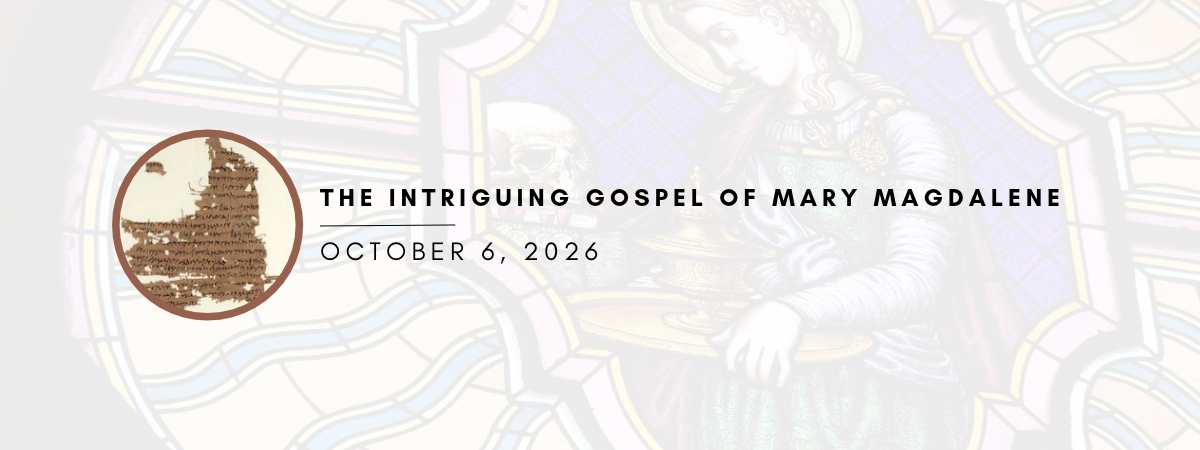
The Intriguing Gospel of Mary Magdalene

This past weekend I hosted an online conference on the relationship of Christian apocrypha to the New Testament canon (apocrypha = Gospels, Acts, Epistles, and Apocalypses that in the end were not included in the New Testament).  There were a number of terrific talks given, one of them by Nicola Denzy Lewis (at Cornell), on the Gospel of Mary Magdalene.   As she was giving it I realized that even though many people are intrigued by Mary Magdalene, few actually know much about this Gospel. I taught it when I did my undergraduate class on ancient Gospels and modern Jesus films, and thought I should say some things about it here on the blog. It is a second-century Gospel does not claim to be written by Mary Magdalene, but she is the main figure in it – the one to whom Jesus gave a secret revelation about ultimate reality, much to the chagrin of the male disciples who can’t believe that Jesus would reveal the secrets of the world to a *woman* instead of [...]

Does Paul Ever Refer to (or Even Know About) Judas Iscariot?

For many years I thought that Paul knew about the betrayal of Jesus by Judas Iscariot.  And I had good reason: he seems to refer to him in  1 Corinthians 11:23-24: “For I received from the Lord what I also delivered to you, that the Lord Jesus on the night when he was betrayed took bread, and when he had given thanks, he broke it and said, ‘This is my body which is for you.  Do this in remembrance of me.” NRSV) Since Paul indicates that the Last Supper happened on the night Jesus was betrayed, that settles it, right?  If so, it would be a relatively big deal, for one thing because otherwise Paul says almost nothing about the events of Jesus’ lifetime. That seems weird to people, but just read all of his letters. Paul never mentions Jesus healing anyone, casting out a demon, doing any other miracle, arguing with Pharisees or other leaders, teaching the multitudes, even speaking a parable, being baptized, being transfigured, going to Jerusalem, being arrested, put on trial, found guilty [...]

2026-09-28T10:22:56-04:00October 4th, 2026|Paul and His Letters|

Did Judas Iscariot Actually Exist? Or Was He “Made Up”?

Over the years on the blog whenever I have posted something about Judas Iscariot (as in my last post), I've had readers ask me whether he was a real person or, as some folk have it, he was made up by Christian story tellers who wanted to explain how Jesus ended up in the hands of his enemies?  Often it is pointed out that "Judas" sounds like "Jew": did Christian story tellers come up with the "Jew" who "betrayed Jesus" in order to make a theological point? I have a definite view about that. I think he was a real person.  Actually one of Jesus’ disciples.  And the one who betrayed him to the authorities leading to his arrest and crucifixion. Why should I think so?  The following explanation is based on the discussion in my book, The Lost Gospel of Judas Iscariot (Oxford University Press, 2006) -- where I start with the question of historical evidence and what "counts": First, in general: What kinds of sources of information do historians look for, when [...]

2026-09-27T17:32:21-04:00October 3rd, 2026|Canonical Gospels, Historical Jesus|
Go to Top